A pipe leaks water, a piece of a ship comes loose, or a sensor must be secured to a submerged structure. On dry land, the solution seems obvious: clean, apply adhesive, press, and wait. Underwater, that recipe stops working as we expect.
The problem isn’t merely about crafting a stronger substance. Before it can withstand pulls, impacts or the passage of time, any adhesive only works if it truly touches the surface it intends to join. And in a aquatic environment there is something determined to occupy that space: the medium itself.
A team led by Qinyu Hu, from Hunan University, has tackled that challenge from a different angle. Their work, published in Nature Communications, asks whether it is possible to combine three qualities that rarely coincide underwater: rapid bonding, long-lasting adhesion and recyclability.
Water places an invisible barrier between the adhesive and the surface
When an object is submerged, its outer molecules are enveloped by a thin layer of water. This coating, known as the hydration layer, can obstruct the intimate contact essential for an adhesive. It’s like trying to shake hands while a slick sheet stubbornly remains between the palms.
When an object is submerged, its outer molecules are surrounded by a thin layer of water, which can hinder the intimate contact essential for an adhesive.
That is why inventing something extremely robust isn’t enough. If the material cannot displace that watery veil, the bond starts at a disadvantage. Moreover, remaining submerged exposes the system for hours, days or years to a medium that can penetrate the contact zone — the interface —, weaken it or alter curing, i.e., the stage at which it hardens.
There are special formulations designed to operate in moist conditions, though many pay a price. Some rely on relatively slow reactions and others require light to harden; they lose effectiveness because water interferes or form irreversible chemical networks that make it hard to recover their components afterward. The research also points to environmental issues associated with certain adhesives containing PFAS, a family of perfluoroalkyl and polyfluoroalkyl substances that are highly persistent and hard to remove.
The decisive question, therefore, arises before measuring how many kilos the adhesion can bear: how to push the water away exactly from the spot where the two pieces must touch?
A current you may have seen in a wine glass
The answer sought by the researchers starts from a physical phenomenon called the Marangoni effect. It occurs when different areas of a fluid’s surface have different surface tensions. That inequality triggers a flow: the liquid tends to move from regions of lower tension toward areas where it is higher.
Surface tension can be imagined, in simplified terms, as a kind of elastic skin created by the attraction between molecules. If that “skin” pulls harder in one place than in another, internal currents appear. A everyday example related to wine is the tears of wine: the alcohol evaporates unevenly and currents arise that make small drops rise and fall along the rim of the glass.
The team saw in that mechanism something more useful than a desk-top curiosity. When well controlled, that flow could swiftly transport the adhesive ingredients, spread them across the substrate — the surface to be bonded — and, above all, exert the push needed to displace part of the hydration layer. The study shows precisely that this current can break the watery barrier and facilitate direct contact.
That flow could rapidly transport the adhesive ingredients, spread them over the surface to be bonded, and exert the necessary push to push aside part of the hydration layer.
But there was another challenge: after pushing its way to the surface, those molecules had to assemble and transform into a cohesive structure robust enough not to wash away in water.
A mixture that enters the water and builds itself
With that objective, the researchers prepared a supramolecular ionic liquid called BP16TPB and dissolved it in dimethyl sulfoxide or DMSO. This class of substance basically contains charged particles, while “supramolecular” indicates that the final architecture depends largely on reversible interactions between its constituents, not on permanently welding them together with new covalent bonds.
When the mixture comes into contact with water, the DMSO begins to leave and the aqueous medium takes its place. That solvent exchange alters the forces that kept the components apart. At the same time, the Marangoni effect drives currents at the interface, favors the spreading of the precursor, and helps to displace the hydration film.
Then comes the central transformation. The BP16TPB units rejoin by hydrogen bonds, electrostatic interactions —attractions between charges— and stacking between aromatic rings —molecular structures in ring form. They concentrate to form a coacervate, a phase rich in associated molecules that shifts from freely flowing to a dense, robust network. It isn’t a prefabricated piece; rather, immersion itself causes that architecture to appear exactly where it is needed.
The result can be measured in seconds. On ceramic, the formulation reached an adhesive strength of 1.1 megapascals, a measure of how much force the bond can withstand per unit area, after only 10 seconds of underwater curing. In five minutes, it reached 1.3 megapascals.
Rather than memorize that unit of pressure, it is worth considering what those numbers meant in practical terms.
The formulation reached an adhesive strength of 1.1 megapascals after just 10 seconds of curing underwater; at five minutes, 1.3 megapascals.
Ten seconds, two kilos and more than three years submerged
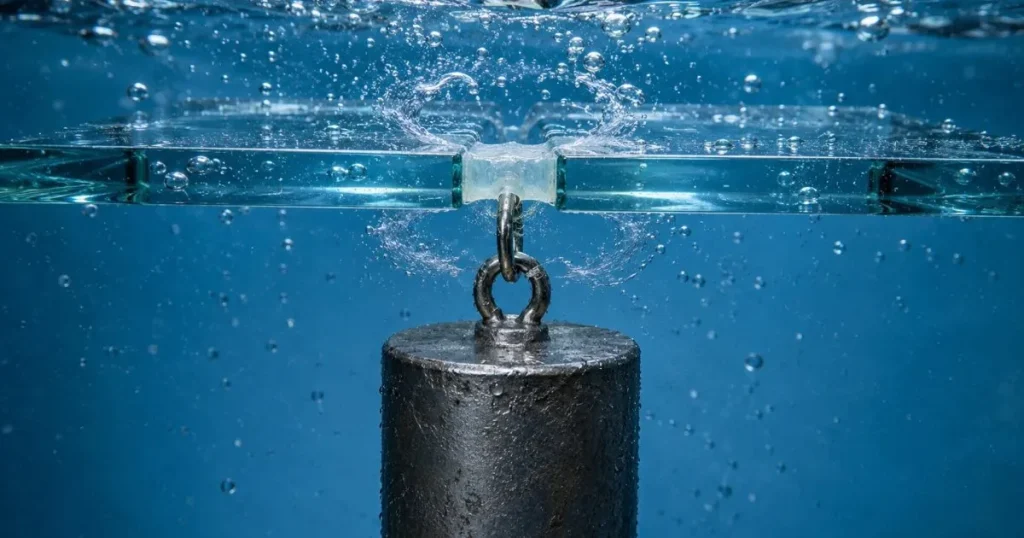
The authors applied the precursor with a syringe onto different substrates. A patch placed on glass remained adhered even after being subjected to a one-minute water jet. In another demonstration, an adhered area of one square centimeter immediately allowed lifting a mass of 500 grams.
The most striking experiment advanced much more slowly. The assembly in question supported a load of two kilograms and endured more than three years of continuous immersion without failing. That doesn’t mean any repair made with this compound will last that long in the ocean, in an industrial pipe, or on a ship hull: it was a static lab test. But it shows that the interface didn’t simply fall apart due to prolonged exposure.
The researchers also measured its behavior on copper, epoxy resin —a widely used plastic in coatings and adhesives— and polyamide —the family that includes nylon—, as well as testing it in acidic, alkaline and saline solutions. The figures varied by substrate and environment, as expected, though the assembly principle continued to work.
The figures varied depending on the substrate and the environment, but the assembly principle kept functioning.
The authors even tested demonstrative applications such as repairing damaged containers or marking hard surfaces of organisms with shells. They are proof-of-concept tests, not products ready for the market, but they help illustrate the leap in scale: a mechanism governed by flows and molecular associations ends up holding objects that we can grasp with our hands.
The strangest part is that its strength comes from reversible bonds
Perhaps the most interesting aspect isn’t how quickly it bonds, but that it isn’t chemically “condemned” to a single lifetime. Many strong materials achieve their toughness through permanent bonds. Detaching them later may require heat, aggressive reagents, or processes that destroy the original structure.
BP16TPB uses a different strategy. Its constituents stay together thanks to numerous non-covalent interactions, that is, attractions that do not amount to creating a permanent chemical link. Among them, hydrogen bonds, electrostatic forces between charges, and contacts between aromatic rings play a role.
A single one of those attractions would be modest; millions working at once can sustain a macroscopic network. The useful comparison is not a wall whose bricks have fused together, but a construction built from countless pieces that fit tightly and, under suitable conditions, can be taken apart to be reused.
That’s what the scientists did. After the tests, they recovered the coacervate, washed it, dried it and dissolved it again in DMSO to prepare a new batch. After eight consecutive cycles, they did not notice an appreciable drop in adhesive performance. Chemical analyses also showed that the composition and fundamental traits of the internal organization were preserved.
“Reversible”, therefore, does not necessarily mean “weak.” The key lies in the cooperation of a multitude of bonds capable of breaking and re-forming.
After eight consecutive cycles of recycling, they did not observe an appreciable drop in adhesive performance.
A glue is only the beginning
The work is far from presenting a tube of adhesive that will hit hardware stores tomorrow. BP16TPB remains experimental, and uses such as repairing marine equipment, fixing sensors to ships, or sealing conduits would require testing beyond the lab.
Its significance also lies in the strategy. The team combined supramolecular chemistry, solvent exchange and a fluid movement phenomenon to ensure the underwater environment participates in the construction. The water stops being merely an adversary: when it contacts the precursor, it triggers the reorganization that enables the adherent phase to form.
Our intuition often links durability to permanence: the harder it is to separate the constituents of a body, the more solid we assume it to be. These networks show another possibility.
An architecture can gain robustness from a multitude of temporary bonds and, at the same time, reorganize itself in the face of external changes. That idea opens a path to designing adaptive, repairable or recyclable materials that respond to the environment rather than merely withstanding it.
Thus, the story returns to the initial question. Underwater, the challenge was an invisible film preventing contact. This approach uses the movement of the very fluid to push it aside and then establishes a firm hold through reversible associations. Sometimes overcoming a hurdle doesn’t require fighting it with more force, but turning the medium that creates it into part of the solution.