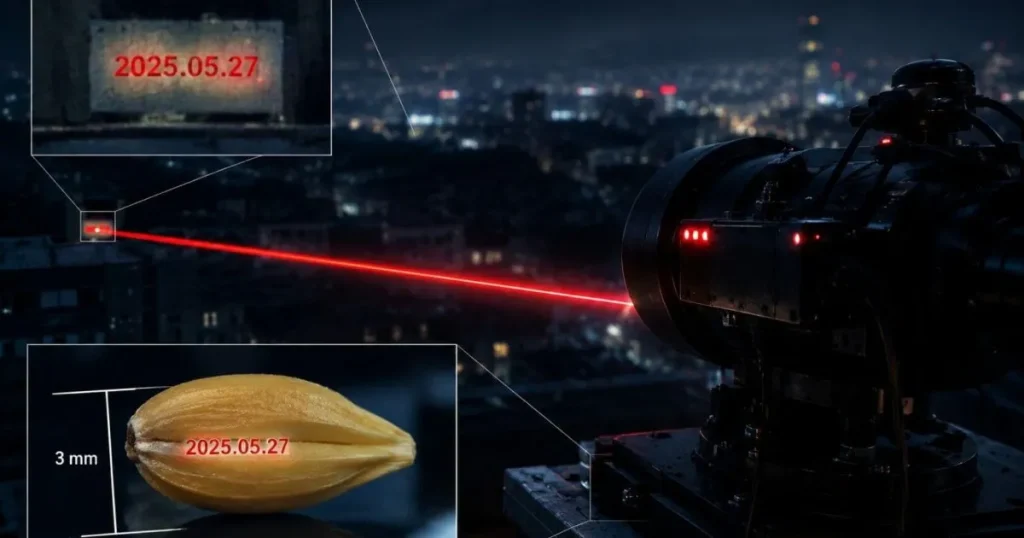
Until quite recently, reading a tiny text located more than a kilometer away belonged to the realm of science fiction. Yet a team of Chinese researchers has managed to turn it into reality thanks to an innovative optical system based on infrared laser beams. The technology is capable of identifying characters only three millimeters tall from a distance of 1.36 kilometers, a precision that allows distinguishing details smaller than a grain of rice without resorting to conventional optical systems.
What is most remarkable about this advance is not only the enormous distance at which it can read, but the technology that makes it possible. Rather than forming an image in the conventional way, as happens with a camera or a telescope, the system uses a technique known as active intensity interferometry. This method analyzes the tiny variations that laser light experiences when reflecting off an object and, using sophisticated algorithms, combines that information to reconstruct the image with extraordinary detail.
This system achieves a resolution that is 14 times higher than the theoretical capacity of a single telescope. If a conventional telescope were used to observe the same target, the only details that could be distinguished would be shapes of at least 42 millimeters in size. In other words, it would see a blurry block where this laser system sees crisp, well-defined letters.
A Tool That Could Change Many Disciplines
Although the term “spy laser” has been the most used to refer to this advance, its usefulness goes far beyond the world of intelligence services. From now on, several sectors are fascinated by its potential.
One of the most enthusiastic is archaeology. Places with ancient inscriptions on cliffs, inaccessible walls, or eroded monuments could be scanned from a distance, without the need for a team of experts risking climbing with ropes or drones. The letters carved centuries ago into remote rocks, for example, could be read with a precision previously impossible.
The possibilities are also enormous in the field of environmental conservation. Thanks to this system, researchers could study fragile ecosystems and observe wild species from long distances, reducing human presence to a minimum and avoiding altering their behavior. In hard-to-reach environments, such as mountains, jungles, or deserts, where installing cameras or sensors is challenging, this technology could become a highly valuable tool for research.
Its potential is not limited to the study of nature. In engineering and heritage conservation, it would enable inspecting bridges, dams, or historic buildings to locate small cracks, deformations, or defects without needing to approach the structures physically. In other words, it not only expands our ability to observe distant objects but also to interpret details that until now lay beyond the reach of conventional optical systems.
El sistema logró identificar caracteres de apenas tres milímetros a una distancia de 1,36 kilómetros, una resolución unas 14 veces superior al límite teórico de un único telescopio.
From Looking at the Stars to Reading Text from Earth
Although it may seem like a completely new technology, the scientific foundation on which it rests has been used for decades in astronomy. Intensity interferometry has allowed observatories to study distant stars by combining information gathered by several telescopes to obtain images far more detailed than would be possible with a single instrument. Until now, however, its enormous complexity had prevented transferring this technique to terrestrial applications.
The major breakthrough by the Chinese team consisted in adapting this physical principle to a much more compact system capable of operating at long distance on targets located on the Earth’s surface. During experiments, the researchers illuminated the target with eight infrared laser beams while two independent telescopes recorded the minute variations in the reflected light. Subsequently, a set of algorithms processed all that information to reconstruct, with high precision, the printed characters, achieving a level of detail that far surpasses conventional optical methods.
This convergence of quantum physics, advanced optics, and computational power is what has allowed a method originally designed for looking at stars to now serve to read labels from the Earth.
A Technology in Constant Evolution
Of course, there is still a road ahead. The system is extremely sensitive to alignment and atmospheric conditions. A slight error in the angle of the laser beams or strong air turbulence can distort the signal. Moreover, the fact that the target must be illuminated visibly with laser light limits its use in covert operations.
Researchers are already working on ways to automate the system, facilitate beam alignment and, above all, incorporate artificial intelligence to optimize the reconstruction of images. It is hoped that these improvements will enable not only reading text but also identifying complex patterns, symbols, or even recognizing objects automatically.
The coming years could bring a new generation of portable optical devices that combine this type of laser with machine learning, changing not only how we see at a distance, but how we interact with the visual world in remote environments.
The article has been published in Physical Review Letters.