
When Robert Walker received a Beanie Baby as a gift for his fourth birthday, neither he nor his parents knew how big of an impact the plush toy would have on his life.
His first stuffed animal, along with the hundreds he now owns, became a form a communication for Walker, who is autistic and now one week shy of his 18th birthday.
Walker’s pets, as he calls them, often spoke for him in situations both inside and outside of school. His pets accompanied him to Creighton Community School from the early years of junior high until well into high school.
Walker graduates from Grade 12 today.
His mom, Laurel, is a Grade 6 teacher at the school and was “shocked” the first time her normally shy son handed out one of his pets for the day.
“He started bringing the pets to school with him in Grade 7 and they stayed with him all day,” says Laurel. “With kids such as Robert, who are on the autism spectrum, the goal is to start removing some of those things because it’s not age appropriate.”
As Robert got older, he was encouraged through his development plan to leave his pets at home for the school day.
“But for him, I knew when he was darn good and ready is when he was going to do it,” says Laurel. “And this is how he stopped taking them to his class.”
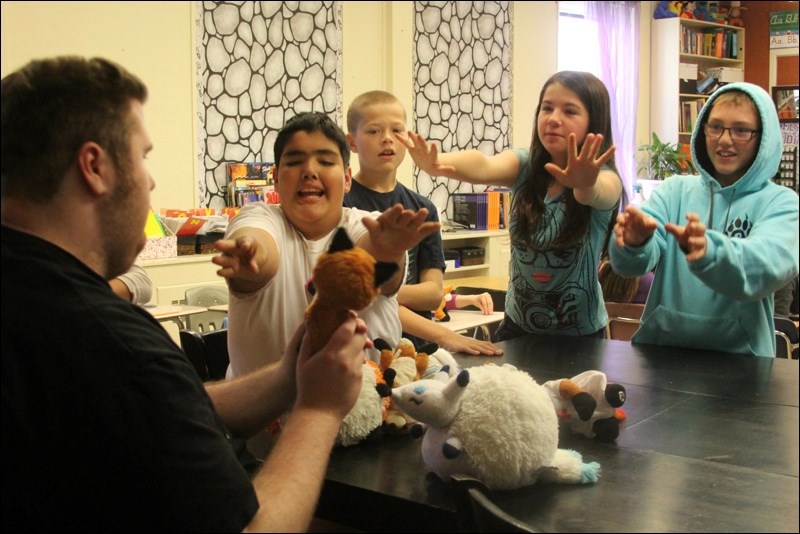
Robert spends every morning in his mom’s Grade 6 class handing out pets for the day for her students to take care of. They rush to Robert with their hands waving in the air for their favourite pet.
“I just wanted to do it,” says Robert. “I just felt like it. I just wanted to share them with the kids in the class.”
Given that her son has always had a difficult time sharing, Laurel says it’s encouraging to see him hand out his pets.
“Robert struggled so much with communication [and sharing] and just to find that way to connect with the kids is so cool,” says Laurel. “Robert has always gotten along better with younger children and adults, so this is an ideal age for him.”
Robert’s classroom visits have helped Laurel’s students understand non-verbal communication.
The class had been studying the book Rules, which explains autism and cerebral palsy in children and their different forms of communication.
“Doing our novel study on a kid with autism, it shows them exactly what it’s like,” Laurel says. “They are able to practise those different ways
of communicating.”
Laurel and husband Rob had broached the topic of Robert leaving his pets at home as he got older, but knowing her son would leave them at home when he was ready, the issue wasn’t pushed.
“For me it was like once you stop bringing the pets, you stop the communication, and to me it meant more for him to be communicating than for him to leave those pets at home,” says Laurel.
As a child, Robert was diagnosed with ADHD. Laurel says her son’s medication hindered his communication with others.
“The medication kind of stifles a kid,” says Laurel. “Sure, it keeps their behaviour in check and it has done wonders for him – it helped him through a lot of rough years – but it inhibits his communication as well.
So by Grade 6 I saidno more [medication]. There is a bigger goal that is more important and we just worked on[communication].”
At age 12, Robert was placed on the autism spectrum.
Now, on his graduation day, Laurel says Robert has grown a lot over the last two-and-a-half years.
“There is such a difference,” she says. “He’s more open and sharing, which is huge for kids like him – and especially something so valuable to trust that those kids are going to look after [his pets].”
Like all parents, Laurel says she and Rob are very proud of Robert as he prepares to walk across the stage tonight to receive his high school diploma.
But this day wasn’t always in their sights.
Robert was born 16 weeks premature, making him a micro preemie. He spent the first three months of his life in the Neonatal Intensive Care Unit in Saskatoon.
“I think back to those days when we were staying in the Ronald McDonald House and he’s in the neonatal ICU for three months,” says Laurel. “You just didn’t know what the next day was going to bring. You’re not thinking about graduation, an adult at 18, you’re just getting through the hours and the days. We’re so proud of him.”
Laurel says Robert’s options are getting better all the time, though she won’t be pushing him out the door anytime soon.
“Being done school and turning 18 in a week are two big transitions that we’re planning for,” says Laurel. “I never encourage kids to go away to school after the first year of graduation and I definitely won’t be encouraging him. He’ll be with us and we’ve got lots of time to make those decisions.
“I’m okay with it and he’s okay with it.”
As for Robert’s pets, Laurel still sees them in her class’s future, somehow.
“I think in some way, shape or form, the pets are going to continue to come,” she says. “I didn’t ever imagine this would happen, but I think it’s a pretty cool project and not to have it continue would be sad.”
And what makes Robert’s pets so lovable?
“They are just so adorable when you look at them. They need to be squished,” Robert laughs.