
Purposefully defined space. That was the buzzword at an open house held last week to unveil plans for the new emergency room at the Flin Flon General Hospital.
The event brought speakers from the Northern Health Region (NHR) and the Northern Health Foundation as well as Architecture 49, which is managing the project.
The need for a new emergency room was first identified in the NHR’s annual health plan in 2008, said Joy Tetlock, NHR’s vice-president of planning and innovation. She said the plan identified numerous shortcomings with the current space. “I think a lot of them I don’t have to point out to you.”
The project’s design development has just been completed, said Tetlock. Working with Gustavo Lecman, Architecture 49’s project manager on the Flin Flon ER, and his team, Tetlock said they have been “going room by room through that layout of what each room will be used for, what is required to have in it, what equipment is going to be stored in that room, et cetera.
“Throughout that whole process we have been consulting with staff,” said Tetlock. Other stakeholders consulted include Hudbay, RCMP and the City of Flin Flon, to review how they will use the facility and be prepared to address their needs.
“We’ve been very conscientious in doing a lot of that consultation because this is one of those once in a lifetime projects ... to ensure that the layout is meeting the needs of all of those individuals that will be utilizing it.”
Impact on patients and staff
Laurel Trubiak, nurse manager for the Flin Flon ER, said the impact on patients and staff would be very significant.
“It’ll be a great improvement,” she said.
With the redevelopment, “We’ll have the ability and the space to do proper and appropriate ER care,” she said
That begins when a patient arrives at the ER. There will be a triage area in the waiting room where a triage nurse will be able to assess patients.
Infectious disease management will be improved. The plan includes an isolation room with its own washroom and an anteroom. “Right now we have to go through leaps and bounds to [handle these cases],” said Trubiak.
A family support space will ensure that family members of patients have somewhere to go while the patient is in care in the ER.
“Right now we use a staff room,” said Trubiak, adding that family members also often wait in the waiting room.
“In regards to the impact on staff, it will be very significant as well,” said Trubiak.
The small ER desk in the current hospital can find two nurses, a ward clerk, a psych liaison nurse and a doctor all working in the same space. “Right now we’re having difficulty finding enough space for everybody to work,” said Trubiak.
Staff will also have a meeting room and a staff room.
New ER features
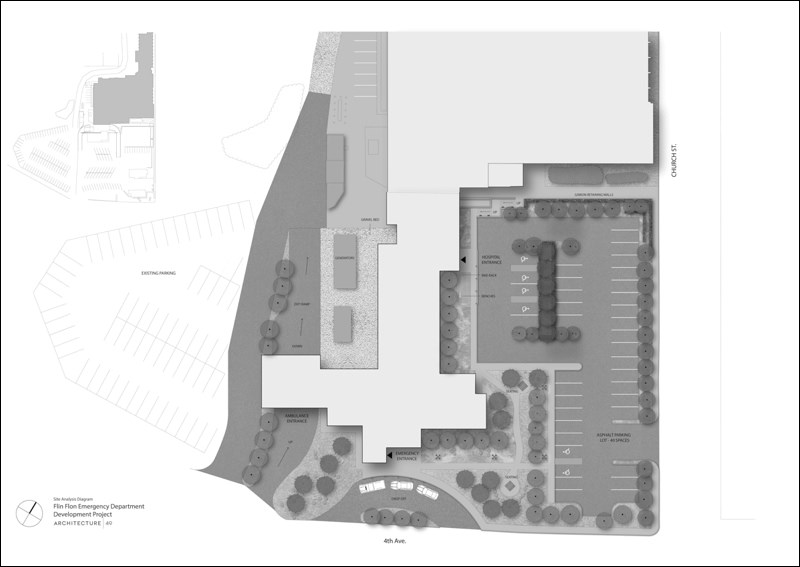
The new ER will be on one level, with access at street level from 4th Avenue. A new main hospital entrance from Church Street will have stairs and ramps from a new parking lot on that side.
Gone will be the ambulance ramp and the elevator that is currently used to provide access to the ER.
“You shouldn’t wait for an elevator in order to go into the hospital. That doesn’t make any sense,” said Lecman. “You should park your car and go in, and you’re there.”
Entry to the ER will be through a waiting room off 4th Avenue for walk-in patients, or through two ambulance bays.
From the ambulance garage, stretchers will be brought into the ER directly or through a decontamination room that allows patients to wash or be washed and changed into gowns before entering the ER.
“We propose that ambulance entrance to be used by Hudbay and RCMP as well,” said Tetlock. “A
lot of the guys that are coming in from Hudbay should probably have their boots and stuff showered off, so it gives them access right there to that decontamination shower.”
A trauma room and procedure room close to both the triage area and the ambulance entry can be combined if necessary to accommodate up to four stretchers. It will be equipped with overhead lights, boom, medical gases, “everything that they need to work,” said Lecman.
Other dedicated spaces include a family room, treatment rooms, an isolation room, an IV therapy room and a point-of-care testing area. A nursing station faces four stretcher bays, with a physician work area behind.
Better processing
Another change with the new layout is that all the emergency room will fill all the requirements for emergency patients.
“When you come in to the new facility, if you’re coming for emerg, you do everything in emerg,” said Tetlock. “You’re not going over to admitting, getting your form, then walking over to emerg and checking in.”
A new main hospital entrance will have admitting for patients using the day surgery or obstetrics, to visiting the clinic or accessing other hospital services.
Repurposing space
The former ER will be repurposed. Lois Moberly, NHR executive director of clinical services for Flin Flon and area, said there is a proposal being made to move material and device reprocessing, which sterilizes equipment for hospital use, into that space.
“There’s been lots of changes over the years with standards,” said Moberly. She said material and device reprocessing is currently being done in a room in the basement that is no longer up to standards.
“We will move them into an area where we will have more room, and it’s direct access to the operating room.”
Energy efficiency
“This is going to be an energy efficient project,” said Lecman.
Lecman said the new ER will tie into the hospital’s existing boiler plant, which meets all codes and regulations and has been under continuous maintenance.
The plant has three boilers. “Even if one of them is failing the other two will meet the capacity,” said Lecman.
Parking
The new plan includes two parking lots, one in the back for staff and one in the front for patients and visitors. Both parking areas will have fewer stalls than current areas. NHR is working with the city to add staff parking behind the hospital.
Lecman pointed out that, with the relocated main entrance, street parking will be an option now for patients and visitors.
Demolition plan
The elevator to the current ER will be demolished, as will the ambulance ramp and a storage space. The only structure to remain on the 4th Avenue side of the hospital entrance will be a stairway. “It’s servicing the six floors of the hospital so it has to stay,” said Lecman. Two houses on the corner of 4th Avenue and Church Street will be torn down.
Demolition is the first thing that will be done on the project and is estimated to begin sometime between December and March-April 2016.
During demolition and construction, the plan is to cordon off the entire build area with a fence.
Access to the hospital and the ER will be from the back of the hospital, and the back parking lot will be utilized. Discussion is underway for the hospital to have access to some of the Whitney Forum parking lot as well.
The back door will be opened, as was done when the elevator was installed. There will be two doors, one for the public and one for EMS (emergency medical services), both with push-button access and security cameras.
Construction timeline
“We think it’s going to be somewhere around a year and a half to two years,” said Lecman, adding that as the architect and not the builder for the project he can only provide an estimate.
“And because we’re planning to use those back entrances during the project we don’t have to do phasing,” added Tetlock. This means construction can go ahead without the disruption of having to move from one construction area to another.
Additional staffing
Tetlock said another triage nurse and health care aides are among new or changing staff positions on the proposal to manage the new ER space.
Flin Flon resident Tom Heine asked about times when Flin Flon had no surgeon in the community, or was without gynecological specialists or anesthetists. He asked about making plans when the NHR can’t meet current requirements at times.
Flin Flon Mayor Cal Huntley, who is also an NHR board member, responded. “I think in all reality, recruiting is always going to be a challenge in any of the businesses we have here. A new facility will probably aid the recruiting process.”
Funding
The project has a $22 million estimated cost, which carries a community contribution requirement of 10 per cent, or $2.2 million, if the money is raised before the tender is awarded.
If the community contribution is not raised in time, it will double to $4.4 million.
“That is policy of Manitoba Health,“ said Tetlock.
Brent Lethbridge, chairman of the board of directors for the Northern Health Foundation, the primary fundraising body for the project, said that although it’s a challenge, he thinks it’s something the community can do.
Funds raised include land credits and credits from utilization by Saskatchewan and First Nations residents, estimated at 47 per cent.
A thermometer on display at the open house showed approximately $790,000 of the $2.2 milliong contribution remaining to be raised.
“I’m thrilled to see a thermometer that’s almost all the way to the top, and we’re just getting traction here,” said Lethbridge. “We haven’t even gone to the citizens of our community who are going to most benefit from this project, to ask them for some donations. I am very optimistic about it.”
He added that a Bollywood fundraiser last September was driven by hospital staff and demonstrated the commitment of the people who are going to be working in the new facility.