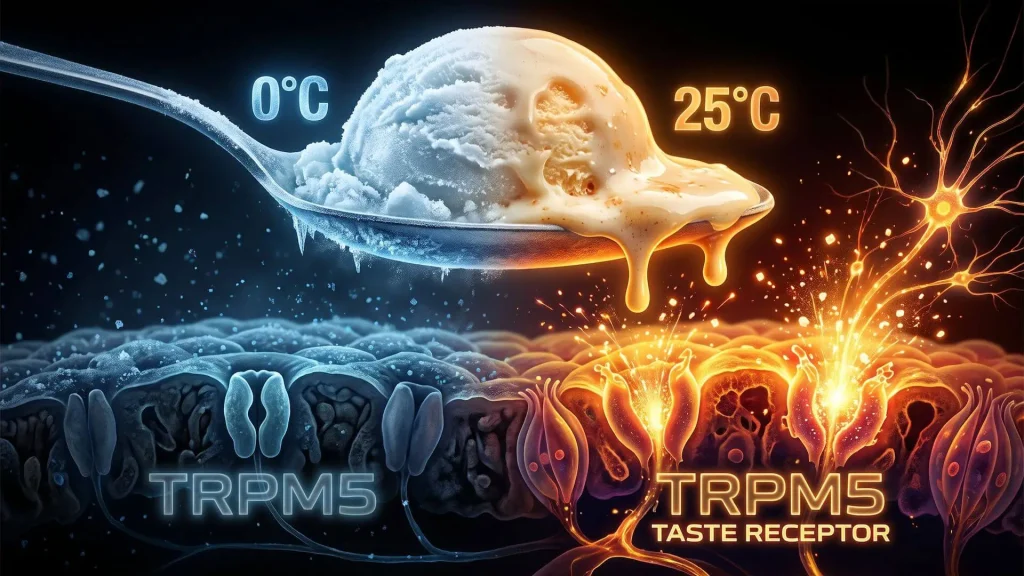
A frozen ice cream and the same ice cream once melted contain exactly the same amount of sugar. Its recipe hasn’t changed, nor has its chemistry. Yet the melted version tastes much cloying. So what has changed, then? Your tongue.
In 2005, Karel Talavera and colleagues described in Nature how the TRPM5 ion channel, present on taste buds, works, and the temperature dependence of sweet receptors.
At zero degrees Celsius, these receptors barely transmit electrical signals to the brain, so the sweetness is hardly perceived. As the food warms up, between about 15 and 35 degrees Celsius, their sensitivity reaches its maximum. That’s why, as the ice cream melts, your receptors send a genuine storm of signals to your brain, while when it is very cold you can barely taste it.
This has a practical consequence. Ice cream makers add a lot of sugar so it tastes sweet when it is completely frozen, that is, when your taste buds hardly respond. The recipe compensates for the cold’s effect on your tongue. But when the ice cream warms up, that sugar reaches receptors in full swing, and what seemed balanced becomes cloying.
So, the next time melted ice cream seems too sweet to you, don’t blame the ice cream: it’s your taste buds that govern the palate.
Santiago Campillo (@Scruzcampillo) is a biologist and science communicator specializing in health, nutrition and nature.