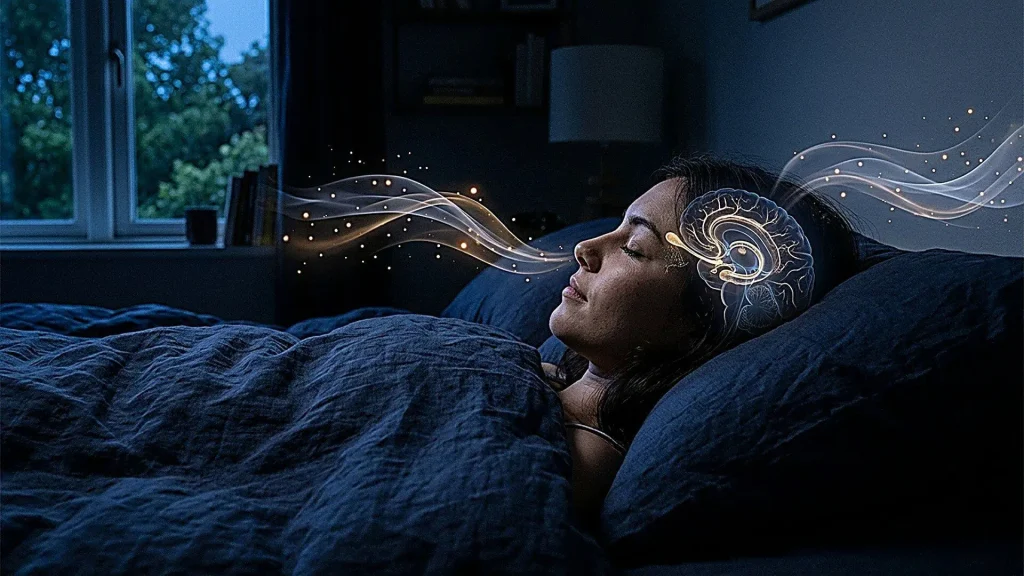
There is a widespread belief that the sharp scent of burning would be enough to alert us if a fire were to break out in the dead of night. Yet science shows that trusting our sense of smell while we sleep is a dangerous trap.
A pivotal Brown University experiment exposed sleeping volunteers to two kinds of olfactory stimuli: a peppermint aroma and pyridine, a foul-smelling substance that mimics smoke. The results were decisive. While auditory signals woke all participants immediately, the odors elicited only faint responses, especially during deep sleep and REM sleep.
The explanation lies in the brain’s own wiring. The vast majority of sensory inputs pass through the thalamus, the structure that acts as a switch and the alert hub of consciousness. However, the olfactory pathways do not route through the thalamus during sleep, so odor molecules fail to generate the activation needed to wake us. It is this anatomical peculiarity that explains why smoke detectors rely on loud audible alarms rather than aroma diffusers.
This does not mean the olfactory system shuts down entirely. Researchers at Heidelberg University found that administering floral or sulfurous essences during REM can alter the valence of dreams: participants exposed to roses reported pleasant sensations, while the scent of rotten eggs triggered nightmares. They did not literally dream of flowers or decay, but the fragrance modulated the emotional tone of their nocturnal narrative.
Santiago Campillo (@Scruzcampillo) is a biologist and science communicator specializing in health, nutrition and nature.