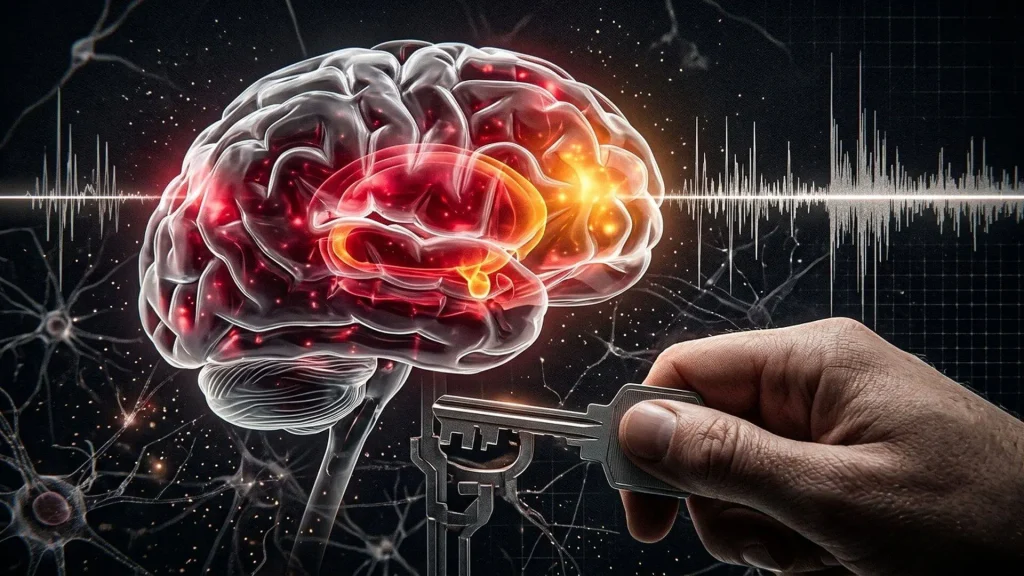
You’re in a hurry, you try to jam the key in at full speed and it slips to the floor. The faster you try to act, the more clumsy you appear. But the fault isn’t bad luck or nerves: it responds to a biophysical law of the nervous system known as the speed-accuracy trade-off, or Fitts’s law.
When you tackle a motor or cognitive task with urgency, the basal ganglia adjust the electrophysiological thresholds that trigger neural signals. In normal circumstances, the dorsolateral prefrontal cortex accumulates enough sensory evidence before issuing the motor command. However, by speeding up the process, the neural circuits deliberately lower that decision threshold.
The problem is mathematical: the baseline noise outweighs the informative signal. The brain executes the motor action before calibrating the exact spatial trajectory, and the error rate inevitably spikes. It isn’t a matter of willpower, but the price the nervous system pays for deciding before having all the information.
Therefore, to be truly fast and precise, neuroscience shows that you must first learn to slow down. Behind a gesture as everyday as opening the front door lies one of the limits of your mind: the brain cannot be as fast and as exact as you would wish at the same time. And understanding that compromise between speed and precision is the first step toward stopping blaming yourself every time something slips from your hands in the rush.
Santiago Campillo (@Scruzcampillo) is a biologist and science communicator specializing in health, nutrition and nature.