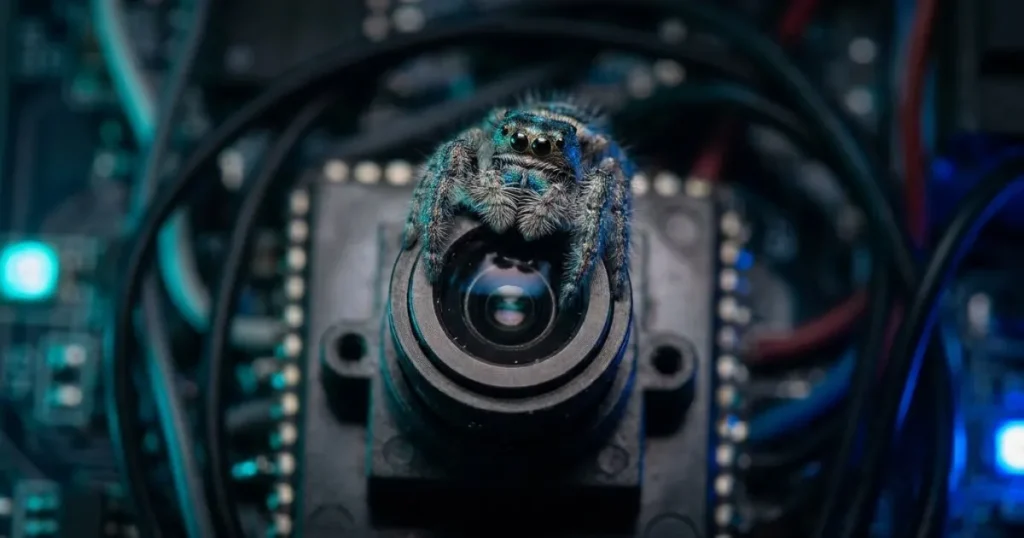
Somewhere on a lit wall, a jumping spider crouches in wait for its prey. It measures less than a centimeter in length, yet before leaping it pinpoint’s the target with a precision that would give many robotic guidance systems a run for their money. It does so without signaling, without projecting infrared light, and with a nervous system that contains no more neurons than are strictly necessary to survive. The trick lies in its eyes: four pairs of layered retinas, stacked with different focal distances, permitting it to gauge the scene’s depth by comparing which parts of the image are in focus and which are not.
That mechanism, honed by millions of years of evolution, is what inspired a team at Northwestern University to create SpiderCam, a passive 3D vision system that generates full-depth maps while consuming 624 milliwatts—less than the power of a nightlight. The project will be presented at the The IEEE/CVF Conference on Computer Vision and Pattern Recognition (CVPR) 2026.
Two photos, one distance
Conventional 3D vision in robotics falls into two main families. The first relies on stereo cameras—two separate lenses that triangulate object positions much like our own two eyes. The second is active: it emits laser or infrared light and measures how long it takes to bounce back. This is the principle behind LiDAR, ubiquitous in autonomous vehicles. Both approaches work well, but both share one drawback: they consume a level of energy that makes them impractical for small devices or those with limited battery life.
SpiderCam pursues a different path, the same one employed by the jumping spider: defocus-based depth estimation. The system captures two images at once with different focal lengths, one perfectly sharp for certain objects and another with a calculated blur. The algorithm, implemented directly on an FPGA (a reconfigurable hardware chip), compares the sharpness differences between the two images on a pixel-by-pixel basis and deduces the distance to each point in the scene. It emits no signal. There is no laser emitter. There is no infrared projection.
The result is a dense depth map at 32.5 frames per second, produced with embedded hardware and without any active light source: a radically different energy equation from LiDAR.
The team led by Emma Alexander, a Northwestern researcher specializing in bioinspired vision systems, with contributions from Matheus Ferreira and Tao Li, has shown that not only does the algorithm work, but it can run in real time with modest computing resources. Funding has come from the United States National Science Foundation (NSF).
Why the spider did it better
Depth from defocus is not a new concept. It has existed as a research field since the 1990s. What hadn’t existed until now was an implementation that combined low energy consumption with real-time processing integrated into the device itself.
The key lies in moving the algorithm onto an FPGA instead of relying on a general-purpose processor or the cloud. A reconfigurable chip can execute highly specific operations with energy efficiency that conventional processors cannot match. It’s the difference between using a machine built for a single task and a universal tool that wastes energy performing functions it does not need.
The jumping spider, specifically the species Hyllus semicupreus, has four main retinas arranged in layers with distinct focal planes. Its nervous system does not perform an abstract geometry calculation: it compares contrast and sharpness signals arriving from those layers and converts that disparity into a distance estimator. It is, broadly speaking, the same principle as the SpiderCam algorithm, but implemented in biological tissue with microwatt-level energy consumption.
There is something unsettling about a creature with the tiniest possible nervous system computing in parallel a robotics problem that has taken us decades to frame properly.
A prototype that knows what it is missing
Be careful not to read this advance as a camera ready to be mounted on a drone. The Northwestern team is clear about this: SpiderCam is a concept-demonstrator prototype, and it has known limitations that will need to be addressed before the technology can be integrated into real devices.
The current field of view is limited, which rules out any real application in autonomous navigation or wearables for now. The optics also require miniaturization: the current setup operates in a laboratory with components that are not yet small enough to fit a consumer drone or smart glasses. Performance under varying lighting or outdoor conditions has not yet been assessed.
What the study does demonstrate, with concrete metrics, is that the principle works: it is possible to obtain dense 3D depth in real time with integrated hardware and consuming less than a watt. That is no small feat in a field where comparable systems demand five to a hundred times more energy.
Biological inspiration, for its part, raises a question that vision engineers have long avoided: if the jumping spider has spent tens of millions of years using this mechanism with negligible energy, what other efficient vision solutions might be hidden in species that no one has yet examined with the right instruments?
The next step is optics
The authors point to three open fronts: widening the field of view, miniaturizing the optics, and testing the system under real-world conditions outside the lab. The FPGA has already shown it can handle the algorithm; the bottleneck now is physical, not computational.
If miniaturization advances alongside the FPGA work, SpiderCam could become the backbone of depth-sensing systems for lightweight drones, visual prosthetics, or augmented reality devices where battery life is a critical resource and latency cannot be measured in seconds. The current prototype’s energy profile already sits within the theoretical viability margins for those kinds of devices.
The challenge is no longer to prove that the principle works. It is to make the optics as small and as efficient as the algorithm that governs it.
The jumping spider spent millions of years fine-tuning its lens. The Northwestern team has something she did not: access to the original experimental results.