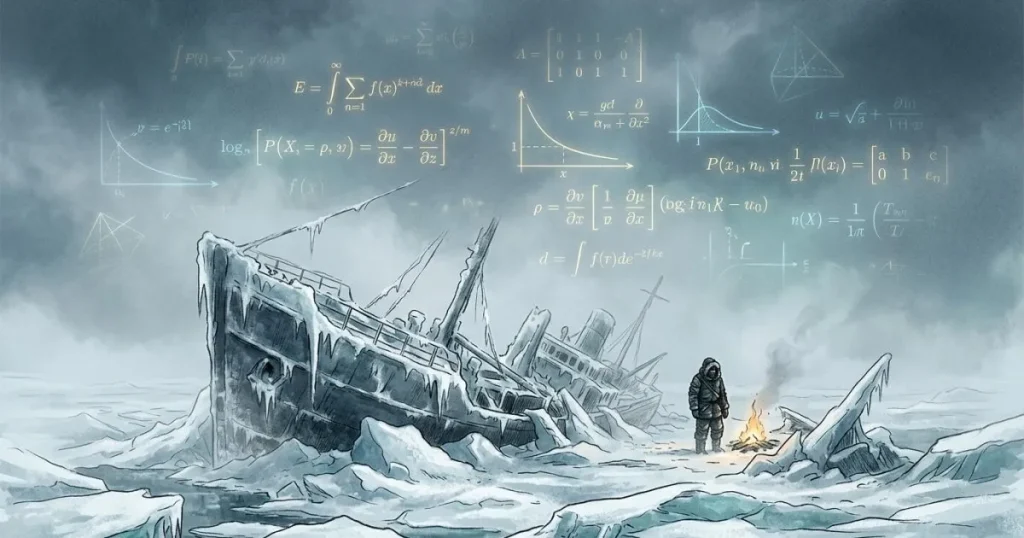
The most common perception of cannibalism places it at a near-metaphysical boundary, a practice so repugnant that culture bans it without further explanation. However, a study published in 2026 in Proceedings of the National Academy of Sciences (PNAS) offers a different and more uncomfortable perspective: rejection of cannibalism (anthropophagy) is not based solely on ethics or disgust, but on the outcome of a biological equation that, in most scenarios, turns out unfavorable.
The work, carried out by Michal Misiak (University of Wrocław) and Petr Tureček (Charles University in Prague), was first presented as a preprint on bioRxiv before its final publication in PNAS. The authors model cannibalism as any other foraging decision: calories obtained against accumulated costs. The surprising thing isn’t that the practice arises in moments of extreme collapse, something already documented in history, but that the mathematics explain why, after the crisis, the practice disappears almost always and leaves behind an extraordinarily resistant taboo.
It is important to clarify a misunderstanding: the model does not propose that cannibalism is a recommended strategy, nor even rational in a broad sense. Over time, it tends to undermine the viability of a population due to the accumulation of costs that are not felt at the moment of the act, but much later. In other words, it is a mathematical model that explains cannibalism’s failure as a durable social practice, not a single isolated episode.
This model is theoretical and rests on historical and anthropological patterns; it does not aim to be definitive proof of a single cause of the taboo: the authors themselves warn that sustained anthropophagy becomes a losing strategy only under most ecological conditions, not in all.
“Our model does not pretend to exhaust the explanation of such a universal taboo, but to offer a quantitative framework that allows understanding why, in the majority of ecological conditions, sustained anthropophagy ends up being a losing strategy.”
(Michal Misiak and Petr Tureček, authors of the study)
The Hidden Cost of Eating
The initial logic is intuitive: consuming human flesh provides energy. In situations of extreme scarcity (such as a prolonged siege, a shipwreck with no provisions, or widespread famine like in Leningrad), that caloric input may seem, for a moment, the difference between surviving or not. The model acknowledges that there are very specific ecological conditions in which the immediate balance is favorable. This explains why the practice recurs episodically throughout history, from the siege of Numantia in 133 BCE, where various classical sources document episodes of extreme anthropophagy among the besieged, to the siege of Leningrad during World War II, recorded in Soviet-era reports.
The shift occurs when the temporal frame is widened. According to the model, the process of digesting human tissue carries a metabolic cost estimated at around 11 kcal for every 500 kcal consumed. It is not a figure alarming by itself, but it underscores that even the most direct energy benefit has its conditions.
The cost of consuming human flesh does not surface at the moment of the act, but long afterward.
This fine print becomes crucial when considering other costs: the risk of disease, the wear on group cooperation, and the violence associated with obtaining the resource. In a broader range of conditions (not the extreme exception, but the everyday reality of a community trying to survive in the long term) the practice proves clearly disadvantageous. What may seem rational in the first minute of a crisis ceases to be so in the thousandth of a second, as disease and mistrust begin to take their toll.
Kuru: the price that took generations to arrive
The case that best illustrates the epidemiological component of the model is kuru, a neurodegenerative disease documented among the Fore people of Papua New Guinea and associated with the ritual consumption of human brain tissue in funeral ceremonies. Kuru is caused by prions, misfolded proteins that are not viruses or bacteria, but that induce other healthy proteins to adopt their abnormal shape.
What makes kuru a revealing example is its incubation period. According to case series cited by Nature News in 2006 from a study published in The Lancet, the disease could take between 34 and 41 years to manifest, with documented cases up to 56, though the average observed in historical series hovered around 12 years. In a classic Nature experiment from the 1970s, inoculating the causative agent into a rhesus monkey produced the disease after 8 years and 5 months of incubation, one of the earliest experimental proofs of its transmissible nature.
A person could participate in the funeral ritual, seemingly healthy, for decades before the damage manifested. This time lag explains why the health cost remained hidden for generations: no one could draw a direct causal link between consumption and disease if thirty or forty years passed between the act and its effect. The taboo, in this case, accelerated when external medical research (driven by colonial patrols and scientific studies in the 1950s and 1960s) made the connection visible.
Shipwrecks, Sieges, and Planes: Episodes, Not Customs
The model is tested against cases of extreme survival well known to popular culture: the sinking of the whaling ship Essex in 1820, the tragedy of the Donner Party in 1846–1847, or the Andes plane crash in 1972. Added to these is the case of the Franklin expedition in the Canadian Arctic, whose bone remains show cut marks compatible with the consumption of human tissue as a last resort in the face of starvation.
In none of these episodes is there evidence of prion outbreaks or of a recurring health collapse, and this does not contradict the model: it confirms it. They are episodic, not ritualized or repeated within a stable community, but isolated responses to extreme and temporary coercion. The health risk rises mainly when the practice becomes recurrent and integrated into a group’s life, not when it appears once under an emergency with no alternative.
Moreover, there is a social lesson in how these cases ended: the Essex survivors or the Andes accident survivors were not treated, upon returning, as permanent moral transgressors, but as victims of a limiting circumstance, reintegrated socially without a perpetual taboo weighing on them. What culture sanctions most strongly is not the isolated act performed under coercion, but the sustained practice, normalized or turned into a custom within a human group.
The Taboo as a Cultural Fuse
Perhaps the most striking aspect of this approach is the inversion it proposes relative to the usual narrative. We tend to think that a moral norm exists first, and as a result, dangerous practice is avoided. The model by Misiak and Tureček suggests a different sequence: first there is a damage threshold accumulated over time (outbreaks of disease, internal violence, loss of communal trust), and that threshold, once crossed, favors the consolidation of a norm that acts as a containment mechanism. It aligns with recent research on cultural evolution: prohibition would be a kind of cultural fuse that was activated long before any biomedical understanding of prions or zoonoses existed.
The prohibition acted as a cultural fuse activated long before any biomedical understanding of prions.
An additional nuance concerns exchange networks. When the consumption of human tissue ceases to be an individual act and becomes part of distribution networks, as occurred in some collective funeral rituals, the number of people exposed to the same pathogen grows exponentially: each new participant becomes a node capable of spreading the problem to others. Since there is no species barrier (the pathogen is already adapted to the human body), any infectious agent present in a body can be transmitted easily to the next consumer, something that does not occur with the same intensity when the protein source comes from another animal species.
This does not imply that cannibalism disappears altogether or that it is simply irrational in any circumstance: in an absolute collapse it can reappear, as extreme survival cases demonstrate. What does not reemerge, according to available historical and anthropological evidence, is sustained practice as a stable system. The notable point in this context is not that cannibalism resurges at the margins of human disaster, but that culture has, generation after generation, found the same mathematical answer to its failure: close the door before the hidden cost fully manifests.
El canibalismo entre humanos no funciona, y no es por cultura, sino por matemáticas
El canibalismo entre humanos no funciona, y no es por cultura, sino por matemáticas
El canibalismo entre humanos no funciona, y no es por cultura, sino por matemáticas
El canibalismo entre humanos no funciona, y no es por cultura, sino por matemáticas
El canibalismo entre humanos no funciona, y no es por cultura, sino por matemáticas