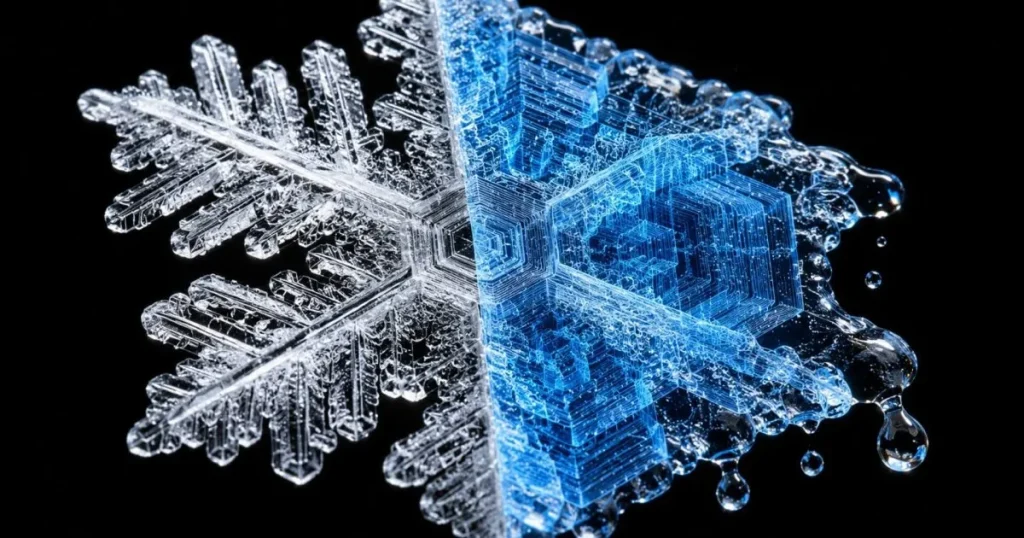
For a few seconds, a snowflake preserves an irrepeatable geometry before turning into water on a temperate surface. The scene looks so ordinary that it hardly invites stopping. Beneath that fleeting disappearance, however, a complex physical remodeling occurs: the branches lose symmetry, the edges retreat, and the ice changes thickness until the figure dissolves.
Traditional microscopy forces a choice about which portion of that metamorphosis deserves preservation. It can magnify a tiny region with high definition, cover a larger area at the expense of detail, or capture many moments at the cost of image quality. Bringing together these three virtues — detail, breadth and speed — ranks among the great challenges of scientific visualization.
A team led by specialists from the University of Connecticut has found another path: instead of refining a conventional camera, they built a lensless device that collects light patterns and uses artificial intelligence to reconstruct what happened. The case of the snowflake provides the most striking demonstration, but the decisive advance, as Nature Communications explains, lies in filming extensive microscopic phenomena as they evolve.
The old dilemma of looking a lot or looking well
The laws of optics impose a tricky trade-off between resolution and field of view. The smaller the structure that defines a device, the smaller the area covered in each shot. If the object changes quickly, a third requirement arises: obtaining enough frames to avoid missing intermediate moments. The difficulty, therefore, is not in magnifying something tiny, but in maintaining simultaneously context, precision and continuity.
That limit raises decisive questions: how does a cellular wound close, when does a bacterium start resisting an antibiotic, and in what way does a micro-needle dissolve within tissue? An isolated photograph shows the before or the after, but does not reveal the full chronology linking the two states. And in that transition lie the answers.
A mural, a mural, and thousands of scattered pieces
A wall strewn with miniatures helps understand the conflict without formulas. Imagine a gigantic mural in a dark room. A narrow flashlight reveals each brushstroke, though it illuminates only a fragment. A broad spotlight shows the overall composition, but it blurs delicate traces. The conventional microscopy resembles that choice: approaching too closely and losing the whole, or stepping back and blurring the texture.
The new methodology replaces that concession with a computational reconstruction. In front of the sensor, it adds a coded mask that modifies the light coming from the material under study. Each exposure looks like a confusing mosaic, not a recognizable print. Yet, those drawings carry hints about the amplitude and the phase of the waves, two properties that allow inferring both the appearance and the optical relief of the object.
Seek the physical state compatible with thousands of successive measurements, reduce the information needed and make possible the recovery of a full three-dimensional sequence.
The algorithm pieces together such clues as one would reassemble a changing jigsaw. It does not fill gaps or invent a plausible version of the snowflake, but searches for the physical state compatible with thousands of successive measurements and takes advantage that nearby moments share much of their underlying structure. That temporal continuity reduces the information required and makes possible the recovery of a complete three-dimensional sequence.
The artificial intelligence that turns signals into video
The authors name their method “spatiotemporal neural representation.” The name may sound abstruse, but the central idea is simple: a mathematical function learns how the sample varies across space and time. Instead of rebuilding each frame from scratch, it links moments to one another, preserves what remains constant, and computes only the emerging changes.
With that design, the prototype achieved a throughput of 20.8 gigapixels per second. It also produced three-dimensional images at 30 frames per second, covered centimeter-scale fields, and resolved lines as fine as 308 nanometers, roughly three hundred times thinner than a human hair. The combination matters more than any single figure: broad reach, high definition, and a cinematic cadence within the assembly.
The filming not only shows a shrinking silhouette but also captures variations in thickness, internal redistributions and losses of geometric balance throughout the entire disappearance of the snowflake.
The snowflake’s melt revealed how the branches withdrew and the fusion fronts advanced. The footage does not merely display a diminishing silhouette; it records thickness fluctuations, internal rearrangements and departures from geometric equilibrium during the whole disappearance. In this way, a familiar phenomenon becomes a dynamic map of alterations that earlier remained mixed, blurred, or out of frame.
The snowflake was the doorway, not the room
Snow acts as an intuitive probe of a capability far larger than its own fleeting image. Its silhouette is recognizable, the ending happens swiftly, and any reader can grasp what is being observed.
But the study was not conceived to unravel a winter mystery. The researchers wanted to test that they could track complex transformations without losing either the big picture or the subtle details.
Their AI-powered platform examined stem cells during wound healing, cell division, necrosis, crystalline growth, bacterial proliferation under antibiotics, and the dissolution of micro-needles designed to release drugs, as well as extreme ultraviolet radiation used in advanced manufacturing.
Each circumstance demands controlling numerous elements at once; focusing on a single one can obscure essential collective behaviors.
The work even extended to the extreme ultraviolet radiation employed in modern fabrication. That application helps characterize beams used in semiconductor lithography, where tiny deviations can compromise microscopic components.
The platform studied stem cells during healing, cell division, necrosis, crystalline growth, bacterial proliferation, dissolution of micro-needles to release drugs, and extreme ultraviolet radiation in advanced manufacturing.
The leap from a crystal of ice to the electronics industry is no extravagance: it demonstrates that this approach works when the classical lens gets in the way, restricts, or simply does not exist.
What the machine does and what it does not
Without replacing actual experimental conditions, the neural network enhances the device. Its task is to relate signals recorded by the sensor and tackle an inverse mathematical problem: starting from the light effects to infer which specimen could have produced them. Reliability depends on calibration, data cleanliness, and whether the physical scheme accurately describes the setup.
That caution separates the finding from the hype that accompanies many AI applications. Here there is no machine “imagining” how a snowflake should melt; there is a procedure subjected to checks with known references, resolution comparisons, and tests in different scenarios.
Even so, turning a lab prototype into a widely used resource will require simplifying calculations, speeding up analyses and validating results under more conditions.
A new frontier for scientific questions
Throughout history, every major instrument has changed what humanity considers accessible. The telescope opened the heavens, the microscope revealed entire communities in a drop, and X-rays penetrated the body’s opacity. This proposal adds another possibility, the ability to survey expansive surfaces of the tiny world with enough speed so that action does not slip away between two captures.
In the end, the reader is left with a more valuable idea than the beauty of the material obtained: scientific progress does not depend only on discovering unknown phenomena; it also advances when a better path emerges to follow the already familiar. A melting snowflake seemed a exhausted story, and, by documenting it with greater depth, becomes proof that even the commonplace holds invisible layers.
A melting snowflake seemed like a exhausted story, and, by documenting it with greater depth, it becomes proof that even the everyday holds invisible layers.
The true discovery lies in widening our attention. Today, the protagonist is a cascade of ice that collapses. Tomorrow it could be bacteria testing resistance, tissues repairing a lesion, or materials that change while they operate. When a technology enables us to witness what we once only intuited, it does not merely offer better observations: it modifies the questions with which we try to understand the world.