
Madrid welcomes Formula 1 this weekend under scorching temperatures. For anyone watching the race from the outside, the driver seems to spend large stretches of the afternoon seated. Yet, simply picturing the fireproof suit, the helmet, the narrow cockpit and a machine subjected to brutal accelerations gives rise to a question that is far more human than mechanical: how does his body keep functioning with such precision in this scenario?
The challenge isn’t limited to enduring an uncomfortable sensation. For almost two hours, the driver must brake, steer, stabilize the head and torso against G-forces, react in fractions of a second, and sustain an extraordinary level of concentration. At the same time, his body generates metabolic heat and tries to shed the excess while remaining enveloped in several protective layers.
A review published this year in British Journal of Sports Medicine gathered the available data on the physiological demands placed on motor racing drivers and incorporated the experience of Formula 1 trainers. Other recent experiments have tested methods to cool them. Together, they allow a partial, at-least, look beneath the suit and into an invisible competition.
Before talking about Formula 1, you must understand how a person cools down
Our inner workings operate within a relatively narrow thermal margin. Although we often speak of 37 degrees Celsius as a fixed figure, core temperature fluctuates with time, activity, and other circumstances. The difficulty arises when we generate or absorb heat faster than we can release it.
The body dilates blood vessels near the skin to transport part of that heat surplus to the surface and activates the sweat glands, whose secreted water can evaporate and carry heat away as well.
The body possesses its own cooling system. When it needs to shed heat, it dilates vessels near the skin to carry part of that excess heat to the surface. It also activates sweat glands. The secreted water can evaporate and, in doing so, carry heat away. It is a formidable biological solution, but it depends on the surroundings.
Sweating, in fact, does not automatically equate to cooling. If the droplets slide off without evaporating, that fluid loss hardly fulfills its cooling mission. High humidity makes evaporation harder because the air already contains a lot of water vapor. Clothing adds another barrier, and limited ventilation further complicates the exchange.
We can imagine the body as an engine equipped with a peculiar radiator: instead of metal, fan, and industrial refrigerant, it relies on blood circulation, skin, and sweat.
If the droplets slide off without evaporating, that fluid loss hardly fulfills its cooling mission; high humidity makes evaporation harder, clothing adds another barrier, and poor ventilation complicates exchange even more.
Inside a monoposto, that mechanism operates while the driver wears fire-resistant underwear and suit, gloves, shoes, and a helmet. Understanding it changes the question. It is no longer about how hot it is outside, but how much heat that person can actually remove.
Inside a Formula 1, the body has two jobs at once
Pilotage isn’t like calmly driving on a highway.
Longitudinal and lateral accelerations force the muscles to support the body; the neck, in particular, must stabilize a head whose apparent weight increases under G-forces, a measure of how many times the acceleration exceeds ordinary Earth gravity.
Longitudinal and lateral accelerations force the musculature to support the body; the neck, in particular, must stabilize a head whose apparent weight increases under G-forces.
The review by Christopher Tyler and colleagues identifies precisely a high cervical load as one of the most characteristic adaptations of these athletes. The work compiled six articles on neuromuscular characteristics and strength, and 19 on metabolic, cardiovascular, and thermoregulatory responses.
The amount seems considerable, but the authors issue an important warning: the scientific backing remains sparse, heterogeneous, and, in many respects, inferior to the practical knowledge accumulated within the teams. Hence, it is prudent to distrust some spectacular figures repeated about F1 as if they applied to any race and any driver.
What we do know helps explain the conflict. Active muscles require oxygen and nutrients; simultaneously, the skin demands greater circulation to dissipate heat. It is like a supply network in which two districts are both demanding higher flow at the same time. The heart must attend to both demands while the athlete continues making decisions at extraordinary speed.
Heat in the environment does not alone create all that effort: it adds to a physical, cardiovascular, and mental demand that was already present.
When the temperature rises, a battle to maintain balance begins
A recent experiment allows better isolation of that tension. Participants performed an hour of exercise in a 32-degree environment with 80 percent humidity, wearing competition gear. It wasn’t a real Grand Prix, and therefore its results cannot be directly translated to the Madrid drivers. That difference is useful: it allows observation of what changes when conditions are controlled.
Without cooling, the skin temperature reached roughly 39.7 degrees and the core reached about 38.3. The important point is not a magical number at which the body stops functioning, but the direction of the process.
As the thermal load rises, the cutaneous vessels dilate and sweating increases to favor, as we say, heat loss. That mechanism has a cost: sending more blood to the surface while other tissues also need it forces the cardiovascular system to continually readjust.
If water is lost through sweat, the circulating fluid volume decreases progressively. To sustain cardiac output—the amount of blood pumped per minute—the heart may need to beat faster.
The brain is not exempt from this equation either. Hyperthermia, that is, an excessive rise in body temperature, and dehydration can increase the perception of effort and, when significant, impair cognitive and motor functions. That takes on another dimension in a sport where a tiny adjustment of the wheel or a late decision can cost a position.
An excessive rise in body temperature and dehydration can increase the perception of effort and impair cognitive and motor functions, when a minuscule steering correction or a late decision can cost a position.
But it would be wrong to turn that possibility into “heat makes drivers make mistakes.” The available literature is too limited to establish such a simple relationship. What is scientifically interesting is something else: the same body that must preserve extreme precision dedicates resources simultaneously to preventing its internal environment from overheating.
Sweat is the solution, but it also creates another problem
We have already noted that every small amount of sweat that manages to evaporate functions as a refrigerant. However, the water used for that purpose comes from the body itself. The greater the loss and the less it can be replenished, the harder it becomes to preserve blood volume and electrolyte balance.
The paradox is easy to visualize: the body spends part of its water reserves to avoid overheating and then must cope with the consequences of having used that resource. Preparation, therefore, begins before the lights go out.
The trainers interviewed by Tyler and colleagues describe strategies such as acclimatisation, which deliberately exposes the athlete to hot environments to foster adaptations, pre-cooling before competing, and cooling during exertion.
Even so, the review itself stresses that many Formula 1 practices still rely more on experience and accumulated observations than on solid studies.
It is wise to maintain that caution. There is no universal amount of fluid loss that every driver experiences in any Grand Prix. Circuit, duration, weather, equipment and individual characteristics modify the outcome. Physiology does not offer a spectacular figure that applies to all; it explains why this difficulty exists.
Trainers describe strategies such as acclimatisation, which exposes the athlete to hot environments in a planned way to encourage adaptations, pre-cooling before competition, and cooling during effort.
Formula 1 has also ended up cooling the driver
The concern ceased to be only about personal preparation. After the particularly harsh conditions of the 2023 Qatar Grand Prix, the International Automobile Federation (FIA) developed specific measures to address extreme thermal episodes. The 2026 regulations formally include the declaration of Heat Hazard or heat danger.
It can be activated if the official meteorological service predicts a heat index above 31 degrees during a race or sprint, or by decision of the race director. This indicator combines temperature and humidity to approximate how both variables jointly determine thermal stress. When declared, the cars must carry the regulatory components of the Driver Cooling System.
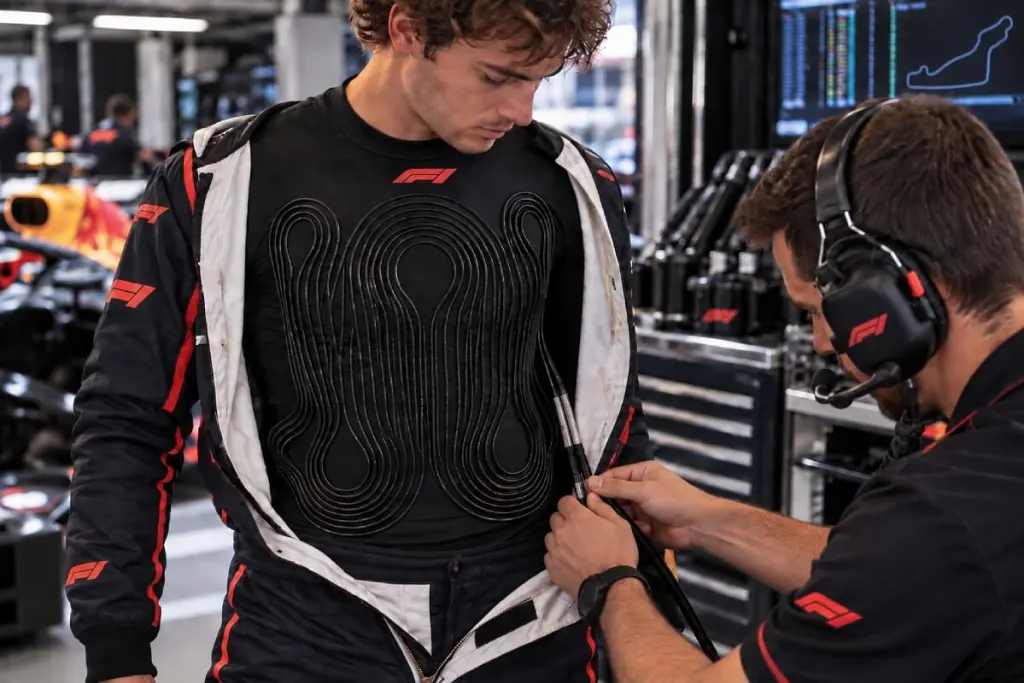
The technical regulation goes further. If the device operates continuously, it must be capable of extracting at least 200 watts of heat from the driver at an ambient temperature of 40 degrees. It also allows solutions based on stored thermal energy, with specific requirements. The permitted media include air, water, and certain solutions.
The idea recalls the biological radiator at the outset. Blood, skin, and sweat form the first line of defense, and engineering can add a second layer when the environment becomes especially demanding. Tests of cooling indicate that intervening in that exchange can alleviate the thermal load.
It isn’t simply a matter of “turning on the air conditioning.” Components must be integrated into a single-seater where mass, space, safety, and reliability matter. The existence of these rules reveals just how much the human being is part of the design challenge.
If the device works continuously, it must be able to extract at least 200 watts of heat from the driver at an ambient temperature of 40 degrees, and stored-energy solutions using air, water, and certain disolutions are allowed.
Heat matters not only because it feels uncomfortable
Feeling hot is the conscious part of a much larger process. Below the surface there are redistributions of blood flow, sweat secretion, cardiovascular adjustments, and efforts aimed at stabilizing the internal milieu. All of this coincides with a task that demands sustained attention and extremely fine coordination.
Exercise science has documented that a high thermal load can worsen physical performance and, in certain circumstances, some cognitive abilities. In auto racing, however, there are not enough data to quantify precisely how much a decision, a braking action, or a lap time changes solely due to that factor.
That absence is revealing as well. The 2026 review emphasizes the gap between what teams know from experience and what has been demonstrated by published research. Formula 1 generates enormous amounts of data about its machines, but we still know surprisingly little about certain limits of the body that drives them.
F1 generates enormous amounts of data about its machines, but we still know surprisingly little about certain limits of the body that drives them.
The right question, then, is not whether a hot afternoon will necessarily slow someone down. It is how to sustain extraordinary precision when a growing portion of physiology is occupied with preserving internal balance.
What happens inside the car explains something much bigger
Let’s return to the driver who seemed to be sitting still. Now the scene is different. His muscles resist accelerations, the heart sustains simultaneous demands, the vessels near the surface dilate, and sweat glands strive to evacuate heat. Meanwhile, the brain must interpret information and choose responses at speeds that tolerate almost no errors.
Formula 1 thus becomes an extreme laboratory of interaction between biology and engineering. We can build faster cars, alter aerodynamics, recover energy, or design materials capable of withstanding extraordinary conditions. Yet at the center remains a person whose physiology obeys much older principles.
That explains why a competition obsessed with tenths, grams, and efficiency has ended up regulating how to cool the driver as well. The whole system isn’t limited to tires or the engine: it includes a body that must preserve an internal environment compatible with both performance and safety.
Madrid’s heat makes this especially clear. Maximum speed may depend on formidable engineering, but part of the system’s limits are still defined by blood, water, skin, and sweat. Long before Formula 1 existed, evolution had already designed the cooling mechanism that today must keep one of the world’s fastest cars running.