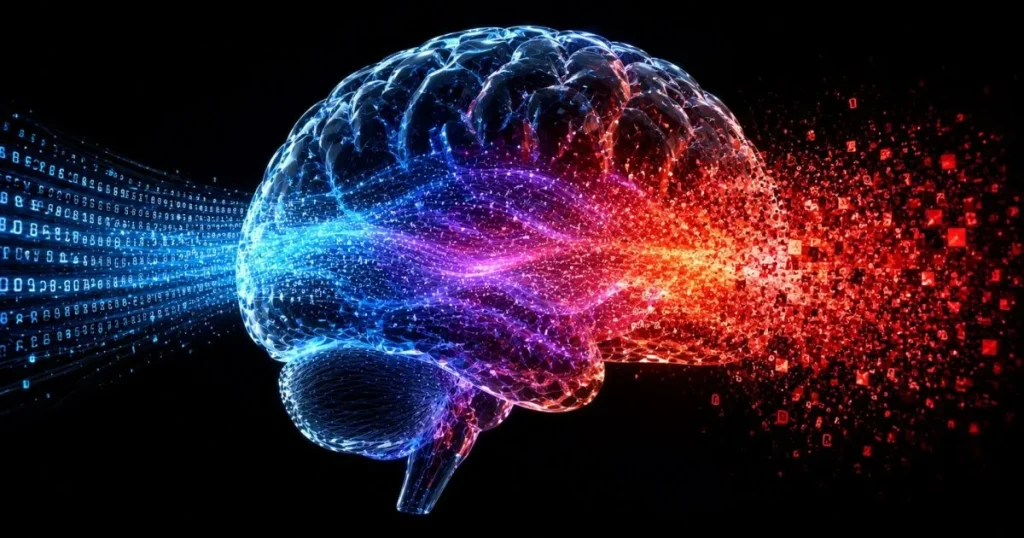
For decades, learning has been understood as an accumulative process. The more experience a person accrues, the greater their knowledge tends to be. That same principle has guided the development of artificial intelligence from its beginnings: feeding a system with enormous amounts of information should translate into progressively more accurate responses.
However, the rapid expansion of tools capable of drafting texts, creating images, programming software, or producing videos has opened an unprecedented scenario. A growing portion of the Internet no longer arises directly from human creativity, but from algorithms trained on vast data sets. That deluge then returns to the net, where it ends up mixing with resources of very diverse provenance.
The consequence raises a troubling question: what will happen when future generations of artificial intelligence come to be nourished mainly by information produced by other artificial intelligences? A study published in npj Artificial Intelligence concludes that this dynamic may gradually erode its performance, though it also describes a strategy capable of containing the phenomenon.
When Copies Begin to Feed on Other Copies
The large language models do not interpret the world as a person does. Their operation rests on detecting statistical regularities within enormous document corpora. From millions of examples, they learn which words tend to appear together, which structures are more probable, and how to complete a sequence with the greatest possible accuracy.
Until a few years ago, almost all of that base came from books, journalistic articles, scientific magazines, websites, or conversations written by humans. That variety offered an extraordinarily rich representation of language, filled with nuances, exceptions, and very different registers.
That panorama is rapidly changing. Each day, enormous quantities of publications authored by conversational assistants appear, automatically generated commercial descriptions, summaries produced by algorithms, synthetic comments, and even full pages produced without direct author intervention. Little by little, that flow becomes part of the immense digital ocean from which the next generations of models will drink.
Researchers use an analogy inspired by endogamy. They do not equate a computer system with a biological population, but they use that analogy to illustrate a simple idea: when exchange is restricted within the same group, diversity declines and certain traits tend to consolidate generation after generation. In artificial intelligence, the risk is that algorithms end up being fed increasingly by productions created by other algorithms.
When exchange is restricted within the same group, diversity decreases and certain traits tend to consolidate generation after generation.
A Wear That Manifests Gradually
That behavior is known as model collapse or model collapse. Far from describing a sudden fault, it designates a progressive degradation. Each new generation trained with a growing share of synthetic data preserves worse the less common examples, intensifies overly familiar patterns, and abandons part of the statistical richness present in the initial corpus.
An analogy helps visualize the phenomenon. Imagine a painting photographed once. Then someone photographs that first copy. Later, another camera reproduces the second image, and so on. Although each reproduction might seem acceptable on its own, small defects accumulate until they alter details the original did preserve. With these systems, something similar happens: information does not disappear all at once, but certain nuances fade as a generation uses the previous one as a reference.
The authors emphasize that the issue does not lie in the existence of synthetic content. That type of material is useful for numerous applications. The difficulty arises when its proportion increases to displace a significant portion of texts, images, or records created directly by people. In that context, the architecture ends up reinforcing what others already deemed more probable, gradually reducing the breadth on which it builds its predictions.
Each new generation trained with a growing proportion of synthetic data preserves worse the less common examples, intensifies overly common patterns, and abandons part of the statistical richness present in the initial corpus.
The consequences go far beyond repeating similar expressions. The work describes a progressive loss of representations that are infrequent, precisely those that allow correct responses to exceptional situations or to grasp less evident relationships. In other words, knowledge ends up concentrating around the most common cases while rarer situations lose representation.
The concern grows because the volume of information generated automatically grows at a rapid pace. Every answer posted to a forum, every automated review, every news item drafted by an assistant, or every product description added to an online store could end up becoming part of the material used to train future generations.
A Formula to Preserve Variety
With that scenario in mind, the team created a family of training functions called Confidence-Aware Loss. Its aim is not to prevent a model from using synthetic data, but to adjust the relevance it assigns to certain examples during learning.
The proposal starts from a simple observation. When a model encounters extremely predictable sequences, it tends to assign them a very high degree of confidence. Those responses, precisely because they are so evident, contribute little new content. If training repeatedly fixates on the same type of patterns, it ends up reinforcing what it already masters while paying less attention to the cases capable of enriching its representation of language.
To avoid it, the researchers designed a variant called Truncated Cross-Entropy or truncated cross-entropy, which reduces the weight of those overly confident predictions. Instead of treating all examples equally, the procedure concentrates a larger share of the effort on the fragments that still contain valuable information. In that way, the model stops disproportionately rewarding the most repetitive and better preserves the statistical diversity of the dataset.
A Challenge That Will Grow Alongside the Internet
The experiments showed a very significant improvement. According to the results, the method allowed models to tolerate more than 2.3 times a higher proportion of synthetic information before exhibiting the characteristic effects of collapse. That does not mean the phenomenon disappears entirely, but it does substantially delay its appearance, widening the margin to combine human-generated and automatically generated content without losing performance as quickly.
The method allowed models to tolerate more than 2.3 times a higher proportion of synthetic data before exhibiting the characteristic effects of collapse.
Another notable aspect is that the authors did not limit themselves to presenting this proposal. They also published an open test suite aimed at systematically evaluating how this degradation evolves when the proportion between original and synthetic material changes. Having a common reference will facilitate comparing future approaches and determining with greater precision which ones yield better results.
The relevance of this research transcends a new mathematical procedure. In fact, it anticipates a difficulty that artificial intelligence is likely to accompany in the coming years. The amount of content generated automatically increases at such a rate that distinguishing between material produced by people and by algorithms will become increasingly difficult.
That shift poses an unprecedented challenge for those designing large language models. Until now, the priority was to assemble ever larger training sets. Going forward, it may be equally important to know the provenance of those data and preserve enough diversity to prevent future generations from feeding predominantly on information synthesized by other machines.
The researchers themselves acknowledge that their proposal is not a definitive solution. The algorithm does not eliminate model collapse nor guarantee the disappearance of all its effects. Its main contribution is to show that this deterioration can be mitigated through a relatively simple strategy, opening a promising avenue for further research.
The study also invites reflection on a much deeper transformation. For years, it was assumed that the web represented a vast library built by millions of people. That image is beginning to change, as a growing fraction of available texts no longer comes directly from human experience, but from systems trained on prior content. As that proportion increases, preserving original sources could become as important a requirement as refining more powerful architectures.
Artificial intelligence has demonstrated an extraordinary capacity to learn. Now it begins to reveal a less intuitive lesson: the quality of knowledge does not depend solely on how much is absorbed, but also on the provenance of what acts as the teacher. In a future where a growing portion of the Internet will be written by machines, the greatest challenge may not be to produce more information, but to prevent algorithms from getting locked into a vast self-training loop.