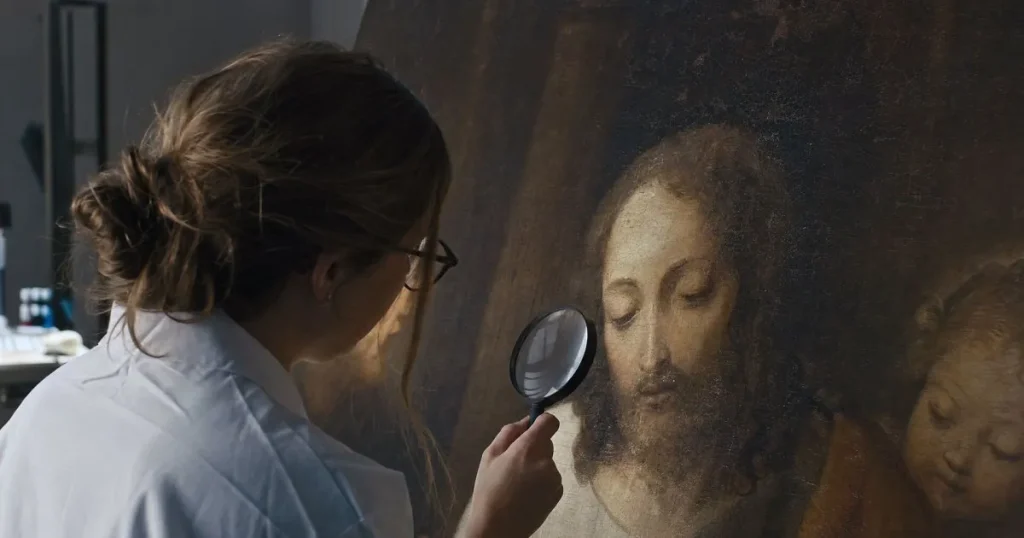
The analysis of pictorial art sometimes begins far from the brushstroke: X-ray imaging reveals a hidden drawing, a new layer of paint, the trace of an unusual pigment, or a handprint that does not belong to the master. Thanks to these techniques, the painting stops being a fixed image and becomes a record of decisions.
Some recent technical studies of artworks show that science can still provide new evidence about the conception, execution, and meaning of these pieces. Let us see how this has been possible with Salvator Mundi, a Diego Rivera mural, the Hall of Constantine in the Vatican, and Sulawesi’s rock art.
The use of new technologies is rewriting the history of art as we knew it.
A World Invisible Beneath the Layers of Paint
What lies beneath Velázquez’s Las Meninas, Frida Kahlo’s El ciervo herido, or Salvator Rosa’s La bruja? Some technologies can reveal what the brushstrokes conceal. X-ray radiography records differences in X-ray absorption: pigments containing heavy elements such as lead or mercury appear with greater contrast and reveal changes in composition, nails, supports, or repainted zones. It does not identify the artist, and its results can become ambiguous when various materials respond similarly.
Other techniques, like infrared reflectance, pass through certain layers and reveal preparatory drawings, i.e., the sketch drawn before applying color. Ultraviolet light, for its part, makes visible fluorescences associated with varnishes, overpaints, and old restorations.
Other techniques, such as infrared reflectance, pass through certain layers and reveal preparatory drawings—the sketch laid down before applying color.
The Technical Anomaly of the Hall of Constantine
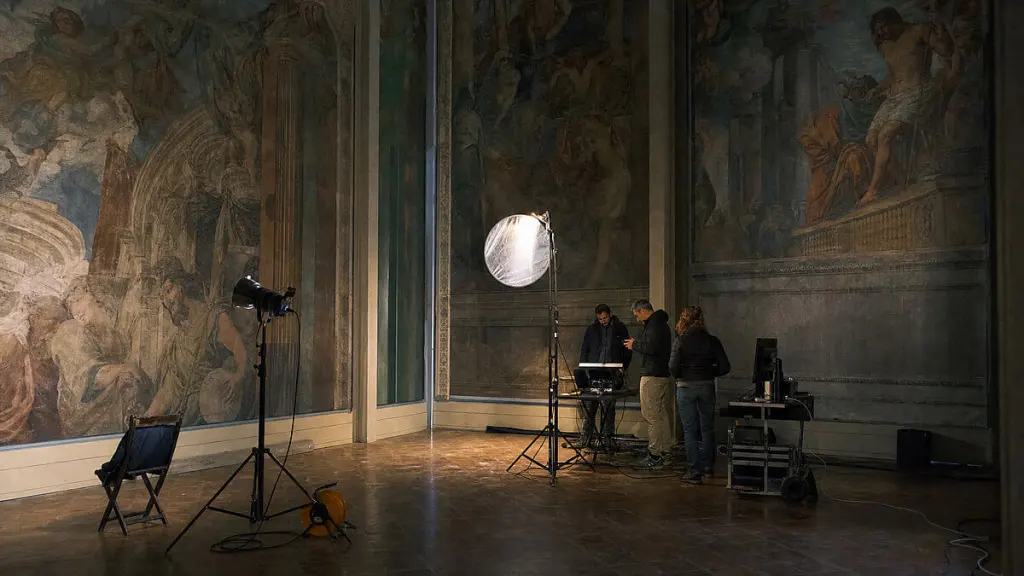
During the restoration of the Hall of Constantine at the Vatican Museums, a technical study detected a revealing irregularity. It was found that two allegorical figures, Justice (Iustitia) and Comitas (Comitas), were not frescoed like the rest of the hall, but painted directly in oil on the wall. This experimental technique is risky, since the application of oil on a wall poses serious adhesion and conservation challenges. The anomaly has been interpreted as material evidence of a testing phase attributed to Raphael’s circle.
From Recipe to Practice
Pinpointing pigments and establishing authorship become markedly more robust when several techniques are combined. Thus, spectroscopy studies how a substance absorbs, emits, or scatters radiation: X-ray fluorescence (XRF) reveals the chemical elements present, while Raman spectroscopy provides molecular and mineralogical information.
Painted between 1922 and 1923, the mural The Creation, Diego Rivera’s first major work, offers a notable example. The tradition described it as an encaustic painting, made with melted beeswax and resins. However, the microchemical analysis published in 2026 in ACS Omega by Aguilar-Rodríguez and his team detected biomarkers compatible with copal resin. Yet no evidence of beeswax was found in the samples examined.
The discrepancy between the described recipe and the material practice may be due to the artist’s reformulation, selective degradation of components, or sampling limitations. In any case, this particular case suggests that what an artist states they did and what they actually did do do not always align.
A microchemical analysis of Diego Rivera’s mural The Creation detected biomarkers compatible with copal resin, but found no evidence of beeswax in the samples examined.
Who Painted It? Crystallography and the Limits of Plausibility
Crystallography deals with the arrangement of atoms in crystalline solids and can identify mineral structures. Its most discussed application in an art context arrived with Salvator Mundi, attributed to Leonardo da Vinci. In a 2026 article in npj Heritage Science, Juan Manuel García-Ruiz and Dianne Modestini examined the minute specks depicted in the transparent orb that the Christ figure holds.
Their interpretation is that these millimetric specks would not be mere air bubbles in the glass, but would reproduce anisotropic fluid inclusions, i.e., small cavities with liquid trapped inside a crystal, typical of a quartz or rock crystal sphere. The polygonal shapes and their correlated orientation would point to the symmetry of a real crystal. If so, the painting would have represented a mineralogical phenomenon more than three centuries before science described it.
The Limits Imposed by Rock
Prehistoric art clearly illustrates the limits of these scientific techniques applied to art. A Nature study published in 2026 and centered on Liang Metanduno on Muna Island (southeast Sulawesi) dated a handprint to a minimum age of 67,800 years. The technique used, uranium-thorium dating, measures the elapsed time since the radioactive decay of uranium present in calcite. The technique thus allows dating the calcite layer that covers the painting, but not the pigment. The figure indicates the hand was pressed at least 67,800 years ago, but it does not fix the exact moment of execution.
Even artificial intelligence, the most recent tool, operates under this cautious logic. Algorithms applied to microscopic maps of texture and surface topography can compare brushstroke patterns and help locate matches, but they produce probabilities and correlations, not verdicts. Their results only make sense when checked against the conservator’s knowledge, the artwork’s material history, and the rest of the evidence. Hence the laboratory does not substitute the expert eye: it merely amplifies it.