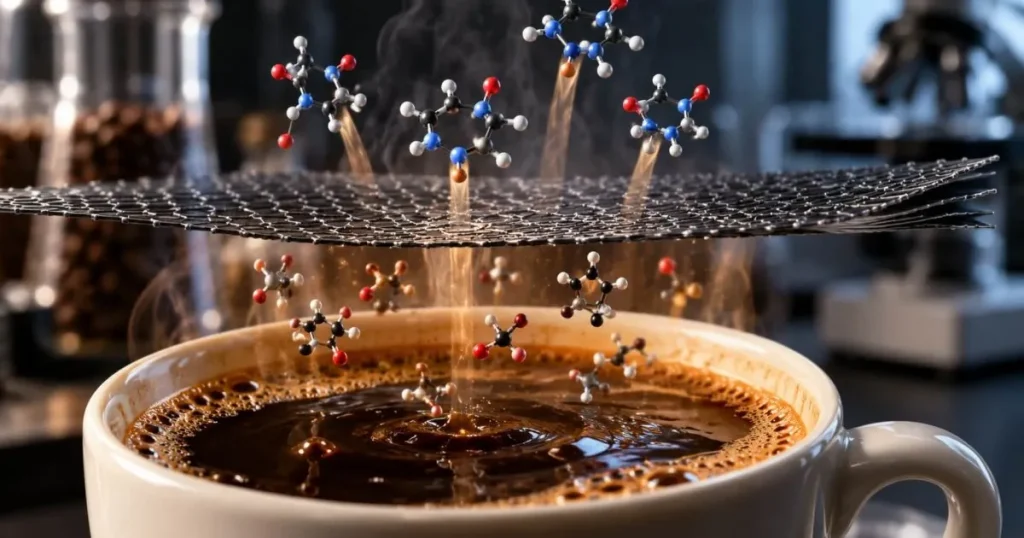
Small choices seem irreversible the moment water touches coffee. If someone aims to cut a substantial fraction of the caffeine, the usual route is to have already bought a decaffeinated variety. Once served, that molecule shares space with a multitude of substances responsible for aroma, composition, and character. Removing it then resembles less pulling a leaf from a cup than isolating a single voice within a chorus.
That everyday problem hides a chemical question far more interesting than it might seem: can we preferentially separate caffeine when the coffee is already prepared without dragging along everything around it? Industrial methods typically act mainly before roasting, treating green beans with water, organic solvents, or supercritical carbon dioxide. They work, but they force you to decide in advance what product you want to drink.
A team from the University of New South Wales and Okayama University has tested the reverse path. Instead of intervening on the grain, Yihan Tian and colleagues experimented with the liquid already extracted and a graphene oxide membrane. Their proposal, published in Journal of Membrane Science, requires understanding something counterintuitive: at the molecular scale, filtration is not just about placing holes small enough.
A Molecular Filter Is Not a Tiny Strainer
The filter of a coffee maker discriminates materials by contrast. Solid fragments are left behind, while the water loaded with dissolved species passes through the paper. If we mentally shrink those pores, it would seem logical to expect the same rule: smaller molecules pass and larger ones get stuck. Nanofiltration is more capricious.
These particles run into a kind of doorman who checks several variables at once. Their size, electric charge, hydration, and chemical affinity with the surface they encounter as they move, the graphene-oxide nanocanals between stacked sheets, all matter. At stake are also attractive or repulsive forces.
A useful analogy would be entry to a nightclub: occupying little space does not guarantee entry if other traits condition admission.
This idea is essential to understand why separating caffeine without chemically emptying the beverage is a challenge. The coffee contains hundreds of compounds, some with similar sizes or responses. A barrier that merely blocks everything above a fixed threshold would lose much usefulness. The authors needed a mechanism capable of distinguishing between candidates, not just a finer sieve.
A Deck of Graphene Oxide Filled with Passages
The graphene oxide sheets provide a nanometer-scale adjustable architecture. This two-dimensional material derives from graphene but carries oxygen-containing groups distributed across its surface. When many sheets are stacked, tiny corridors arise between them, through which water and dissolved substances circulate.
The researchers modified these passages by adding sodium alginate and using calcium ions as stabilizing cross-links. The alginate intercalates between the layers, and the calcium cross-links them, i.e., links chains and reorganizes the whole. With this, they vary the distance between sheets, their electrical behavior, their interaction with water, and their stability.
The combination produced several membranes with distinct performances rather than a single incremental improvement. Increasing alginate or strengthening cross-linking did not automatically yield better results. In that environment, transport, adsorption, and confinement compete: boosting one attribute can harm another. The optimal alternative had to reconcile these demands.
By stacking many sheets of graphene oxide, tiny corridors arise between them through which water and dissolved substances move, which were modified by adding sodium alginate and, additionally, calcium ions as stabilizing linkages.
Then Came the Moment to Let the Coffee Flow Through
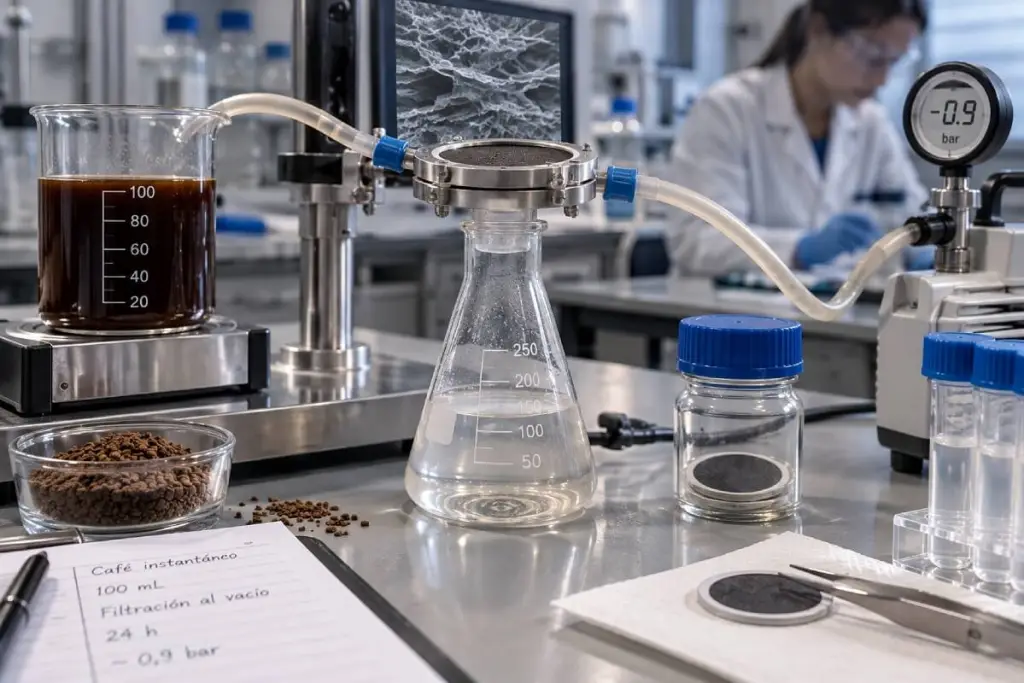
The principal test used 100 milliliters of a solution prepared with commercial instant coffee. The researchers selected Moccona Classic, at a concentration of one milligram per milliliter, and carried out vacuum filtration for 24 hours, with a pressure difference of about 0.9 bar, slightly below atmospheric. This isn’t a device meant to sit on a cup: it is an experimental demonstration.
The procedure inverts our intuitive image of what a filter should do. Here, the desired product is not the liquid crossing the barrier. The caffeine must leave it preferably, while a larger share of other components remains on the initial side. The valuable product is that coffee retained. The membrane therefore functions as a selective pathway for certain constituents of the mixture.
The authors measured another four s substances alongside caffeine: choline, trigonelline, 5-hydroxymethylfurfural (HMF) and N-methylpyridinium (NMP). These substances are part of coffee’s intricate composition and allow checking whether the process carries away something more than caffeine. They are not equivalents of the full flavor, but they serve as references to verify how much the process affects more than the targeted compound.
Almost 47.4% Less Caffeine
The variant named CGSM-1 lowered caffeine concentration from 24.64 to 12.95 micrograms per milligram. The drop reaches 47.4 percent, so “half” reasonably captures the key figure behind the headline. Choline, trigonelline, 5-hydroxymethylfurfural and N-methylpyridinium remained present in measurable amounts.
That 47.4 percent does not turn a regular drink into decaffeinated. The paper’s own reference is telling: the commercial sample used for comparison contained 0.52 micrograms of caffeine per milligram, versus the 12.95 obtained with CGSM-1.
Thus, we’re talking about a partial decrease, not a replacement for the techniques currently used by the industry.
Caffeine concentration was reduced from 24.64 to 12.95 micrograms per milligram, a 47.4 percent drop, and the other representative substances remained present in measurable quantities.
We also don’t know whether the treated coffee tastes the same, because the experiment did not include a sensory tasting. The persistence of relevant markers does not automatically equate to an intact aroma. The team warns of another boundary: they did not quantify total polyphenols. This caution frames what was discovered. The device removes caffeine within a real-matrix, and it remains to be seen what impression it would leave in a cup.
The trick, then, is not to eliminate the entire mixture, but to gain a certain preference for one particular component.
The Heaviest Molecule Found the Easiest Exit
The most instructive surprise arises when comparing the masses of the five substances studied. N-methylpyridinium reaches 94.1 daltons; choline, 104.2; 5-hydroxymethylfurfural, 126.1; trigonelline, 137.1; and caffeine weighs in at 194.2. A dalton is a tiny unit used to express atomic or molecular mass.
That caffeine is the heaviest substance did not prevent it from escaping with the greatest ease.
Following the intuition of the strainer, one would expect the heaviest compound to have greater difficulty advancing, but the opposite happened: caffeine exhibited the smallest rejection among the five molecules. Being the heaviest did not stop it from escaping more easily.
Choline provides the contrast. Although lighter, it carries a permanent charge and shows a marked affinity for aqueous media, and these traits favor interactions with the oxygen-containing groups of graphene oxide, the alginate chains, and the calcium-related hydrated zones.
The journey through the nanocanals thus depends on a physical-chemical negotiation, not on a microscopic ruler. Confinement, electrical state, hydration, surface affinity, and various forces act in concert. Caffeine is less ionized under the study’s conditions and can adsorb—i.e., temporarily cling to the material’s surface—and desorb during its passage.
Caffeine is less ionized under the study’s conditions and can temporarily adhere to the material’s surface and release during the journey.
Our molecular nightclub, in other words, does not give priority to the most frequent visitor: each candidate maintains a particular connection with the environment it tries to cross. Thus, at the molecular scale, occupying less space does not guarantee getting to the other side first because who you are matters as much as the volume you occupy.
From the Laboratory to a System That Could One Day Be Scaled Up
The group subsequently transferred the chosen solution to hollow-fiber membranes. They built arrays of 23 polyvinylidene fluoride (PVDF) tubes, a durable polymer used as support, and coated them with a selective film of graphene oxide, alginate, and calcium.
This geometry concentrates a large active area in a small volume and brings us closer to systems where coffee could flow and be filtered continuously. And the fact is that tests with these fibers extended operation up to 96 hours and maintained promising performance.
That does not place a household device at the market’s doorstep. Answers about processing speed, durability, costs, coffee varieties, sensory perception, and scalability are still missing. Even the main trial took a full day. Turning a nanofiltration demonstration into a fast, affordable, and reusable utensil opens another technological storyline.
To prevent a spectacular figure from masking shortcomings elsewhere, the researchers created a multicriteria method. The assessment combined caffeine removal, retention of markers, retention of choline, water permeability, and concentration increase. That balance identified CGSM-1 as the most suitable alternative. Optimizing a membrane, therefore, requires embracing trade-offs between competing properties rather than chasing an isolated record.
What a Cup Teaches About the Molecular World
The possibility of acting once the coffee is ready upends our intuition about how matter is separated. In daily life, we classify objects using clear signals: a sieve discriminates by dimensions, decanting takes advantage of densities, a screen lets through the smaller pieces. When you descend to nanometers, those rules stop being enough, andeach molecule encounters a different path depending on its properties and its relationship with the surrounding material.
Designing a molecule’s surroundings can be as decisive as fabricating a hole with a defined width. That is the lesson that transcends caffeine. By adjusting charge, hydration, affinities, and confined spaces, a barrier can distinguish mixed substances even when the heavier one encounters less resistance. Engineering thus stops building passive walls and begins organizing microscopic landscapes with preferences.
A cup of coffee makes that idea tangible. The prototype is still far from letting us brew an espresso and lower its caffeine at will, but it demonstrates that this capability does not have to belong to the bean. Perhaps the most intriguing takeaway is that some future filters will not merely stop the large molecules but learn what distinguishes each molecule.