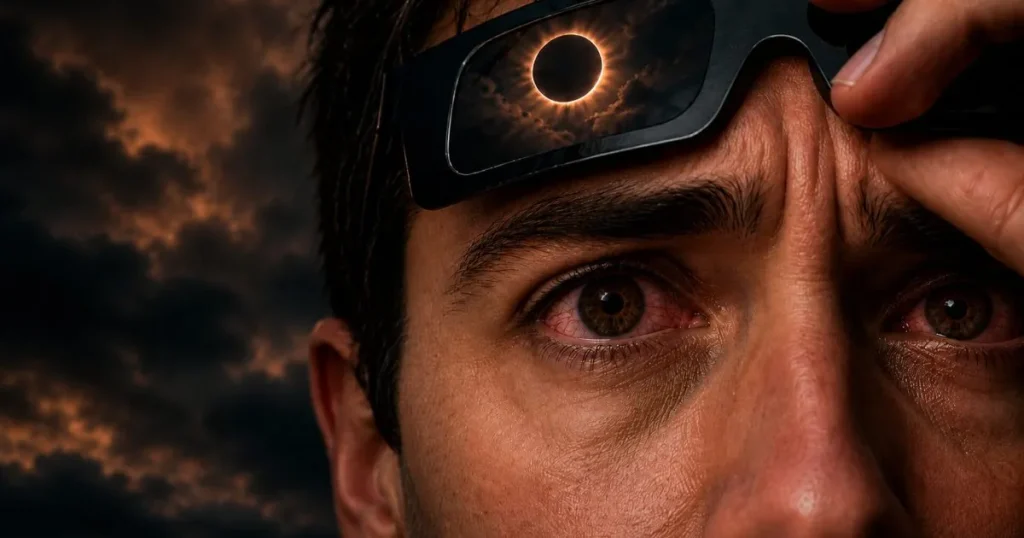
On August 12, 2026, millions of people across Spain watched a spectacle that had been absent for more than a century in much of the Iberian Peninsula. The Moon crossed the solar disk and, within the path of totality, the landscape briefly sank into an extraordinary darkness.
As photographs flooded social networks, Google Trends recorded in Spain a striking rise in searches for “eye pain.” In the United Kingdom, something similar happened with expressions such as “eyes hurt” or “my eyes hurt after eclipse.” But an internet search is not a diagnosis, nor do those symptoms prove an injury.
The practical question is different: what happens inside the eye after looking at the Sun without the necessary safety measures? Answering requires understanding how we see, why an eclipse fosters a behavior we usually avoid, and which signs should worry us. Only then does that collective worry make sense.
Google captured the nervousness of spectators
IFLScience has drawn attention to the Spanish rebound of “eye pain” after the eclipse. British data showed a similar coincidence and also saw expressions linking that discomfort to the phenomenon. Google Trends does not reveal who watched the Sun or whether they suffered damage; it measures relative interest, not medical histories.
The scene was also not new. After the total eclipse in the United States on April 8, 2024, Ethan Waisberg, Joshua Ong and Andrew Lee analyzed in the journal Eye another surge of “my eyes hurt.” The expression became a trend at the start of the eclipse, and several states along its path registered some of the highest levels of interest.
In Spain, moreover, concern reached hospitals. The Gregorio Marañón Hospital went from about six typical nightly ophthalmology visits to nearly thirty; eleven communities recorded more than 300 eclipse-related consultations, mostly mild. That gap between fear and actual injury is precisely what needs to be clarified.
To understand what happens, you have to travel inside the eye
Seeing may appear to be a passive action, but the eye functions as a refined optical system. Light passes through the cornea, traverses the pupil —which regulates how much enters— and reaches the lens, a flexible element that contributes to focusing. The journey ends at the retina, a thin, light-sensitive layer at the back of the eye.
Think of the eye as a biological camera. The cornea and lens act as lenses; the retina plays, with many differences, a role similar to the sensor. There, photoreceptors convert that energy into signals processed by the brain.
At the center lies the macula, specialized in perceiving subtle details. Within it is the fovea, a tiny region crucial for reading or recognizing faces. When we focus on a detail, its representation falls onto that zone of maximum precision.
That is the vulnerable point. The eye itself concentrates radiation on a tiny area. Solar retinopathy arises when intense exposure triggers a photo-chemical deterioration: light initiates harmful reactions in retinal cells. “Burn” is a useful way to visualize the outcome, though the main mechanism is not simply heat.
Solar retinopathy arises when an intense exposure triggers a photo-chemical deterioration: light causes harmful reactions in retinal cells.
The eclipse does not make the Sun more aggressive
The Moon does not transform solar radiation into something mysteriously more potent by simply being in front of it. The danger arises primarily from our behavior. On any clear day we quickly avert our eyes from the dazzling star; during an eclipse, the opposite happens: the phenomenon invites us to look.
The partial occultation generates a deceptive sense of harmlessness. Even if only a fraction of the photosphere remains visible, it remains too intense to gaze at directly with ordinary means.
NASA recalls that the partial phases require specific protection and that only during totality, when the Moon completely covers the disk and if the observer is within its path, can one remove it in that brief interval. Even a small portion uncovered is enough to make it unsafe not to look away.
The eclipse does not create new radiation, nor something different or less harmful, but an exceptional situation that invites you to keep staring.
Thus, while the eclipse temporarily hides a large part of our star, it amplifies the urge to direct the eyes toward it. Therein lies the trap: it does not generate new radiation, nor something different or less dangerous, but an exceptional situation that encourages prolonging the act of staring.
The most serious injury perhaps does not announce itself with pain
Our experience suggests a reassuring rule: if something harms the body, it will hurt and we will withdraw. We touch a hot object and remove our hand; dust under the eyelid causes irritation. With the retina, that warning channel does not work the same.
In some cases, solar retinopathy develops without pain while the exposure lasts. That tissue lacks pain receptors that would act as an immediate signal. Therefore, a person may continue watching the eclipse, feel fine, and only later discover that their vision is no longer the same. Moorfields Eye Hospital in London warns of that possible delay.
Solar retinopathy develops without pain while the exposure lasts because that tissue lacks pain receptors that would act as an immediate signal.
The paradox clarifies those Google searches. Itching, grittiness, burning or irritation do not by themselves equal retinal damage. José Luis Urcelay, head of Ophthalmology at the Gregorio Marañón Hospital, explained that many patients arrived with those sensations, while the injury characteristic presents as visual disturbances: “If there is real damage, it will manifest as central vision loss or obvious distortion in how images are perceived.”
Consequently, it is worth reframing the question: instead of asking if your eyes hurt, see whether you see as well as before.
What does a person notice if the retina has suffered
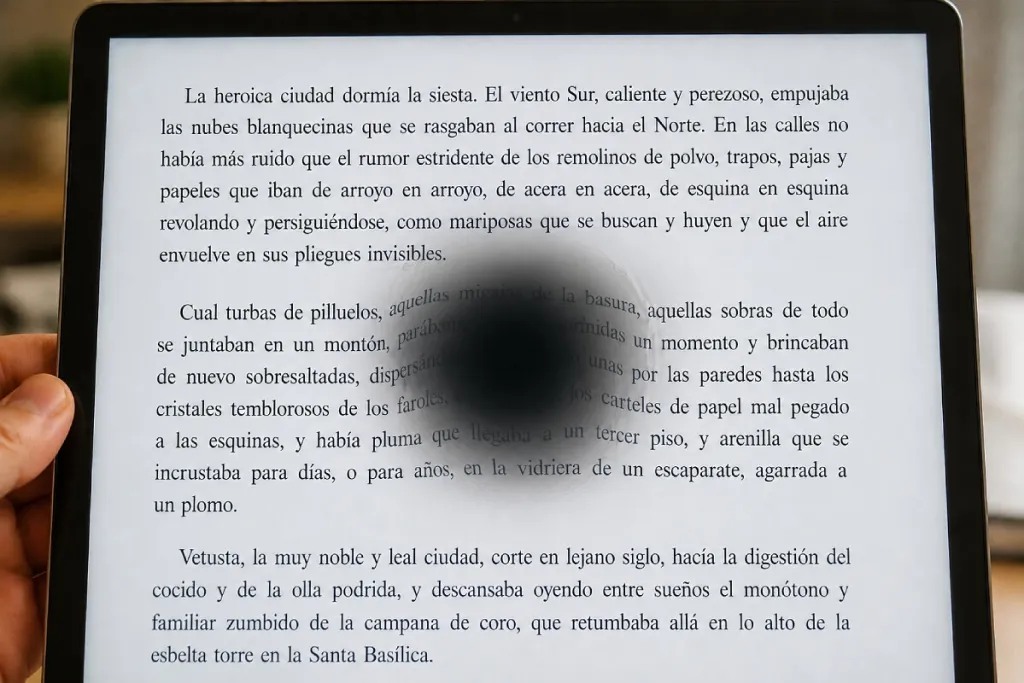
The relevant symptoms affect what we perceive: blurred vision, a central dark spot, difficulty deciphering text, altered colors, or heightened sensitivity to light. Some people experience metamorphopsia, meaning a deformation of what we see: a straight line, for instance, begins to appear curved or wavy.
Imagine someone arriving home calmly. Later, they unlock their phone and discover that several letters become blurred where they try to read. They move the device, blink; the anomaly remains in the same area.
That experience helps detect a scotoma, the name for a missing or abnormal area of the visual field. If it occupies the center, it sits right where we try to focus on details.
Location matters: a small macular defect impedes everyday tasks like understanding a text, driving, or recognizing a face. The severity, on the other hand, is not measured by how much it hurts, but by which visual abilities have been diminished; and the problem appears in one or both eyes depending on how the exposure occurred.
The severity is not measured by how much it hurts, but by which visual abilities have been diminished.
Previous eclipses had already issued a warning
The study published in Eye following the 2024 North American eclipse reviewed clinical histories. One of the most revealing came from the total eclipse witnessed in the United Kingdom in 1999. In the largest subsequent national study, 70 cases of vision loss were reported; half were documented within the first two days and 84 percent initially showed macular abnormality.
The evolution adds an essential nuance. No one continued to lose vision beyond six months. Another cohort of twenty patients found three central scotomas still present at seven months, resolved in follow-up at twenty-one months.
Solar retinopathy does not inevitably lead to permanent blindness, but it is not a mere scare either. Specialized publications record numerous recoveries along with cases in which sequelae persist.
On the other hand, there is no proven treatment capable of reliably repairing the deteriorated tissue; preventing exposure remains the fundamental tool. The prognosis depends on severity and varies from person to person.
Therefore, the prior warnings are not an exaggerated formality but the main barrier against a potentially irreversible harm. Prevention is crucial because medicine can diagnose the injury but cannot guarantee undoing it.
If you looked at the Sun, pay attention to how you see afterward
Anyone who looked directly at the Sun without protection and notices a new disturbance should seek an ophthalmologic evaluation; especially, if there are central spots, blurring, distortions, color changes or a decrease in sharpness. The absence of pain does not rule out the problem; some manifestations take several days to appear.
The peak of “eye pain” in Google searches cast a digital shadow after the August 12 eclipse. It revealed fear, but it does not allow counting injuries. Spanish hospitals registered many visits and very few severe cases in the initial balance.
We tend to conceive itching as a universal alarm that buys time to stop a dangerous action. The retina shows that the body does not always extend that courtesy: sometimes it suffers without warning as it happens.
Nuestras sensaciones no son un medidor perfecto de seguridad y, a veces, conocer el cuerpo protege mejor que esperar a que proteste.
If you witness future eclipses
For future eclipses, it is important to be clear that ordinary sunglasses do not suffice, even if they seem very dark. Solar viewers must meet the ISO 12312-2 standard and be in good condition. Binoculars, telescopes or cameras require specific filters placed in front of their optics. You can also project the Sun’s image onto a surface through a small pinhole, never looking through it.
During partial phases, we need an appropriate barrier because, as we have said, only during totality can the corona be viewed without filters. But there is no need to push that moment: if there is any doubt about when the first bright fragment will reappear, the prudent choice is to keep the protection on.