In 2026, we use artificial intelligence to draft, program, seek information, or generate images. None of this appears to be the opening of an apocalyptic movie. Yet leaders and researchers from cutting-edge laboratories speak openly about catastrophic threats and about progress that could outpace our ability to keep these technologies under control.
What is truly perplexing is the time horizon. We are not merely debating a distant future, but the coming decade. Some forecasts foresee extraordinarily rapid leaps before 2030; others consider it unwarranted to extend current trends to that extent. Between these positions lies a vast margin of uncertainty.
The interesting question is not whether an AI chatbot today could destroy us. It is this: what would have to happen between today’s artificial intelligence and a machine that could threaten our survival? To answer it, it is useful to reconstruct that trajectory and check which steps are already in place, which are starting to take shape, and which remain hypothetical.
Before calculating the end of the world, it’s necessary to understand what “existential risk” means
A computer glitch, a disinformation campaign, or even a large cyberattack can cause enormous damage without threatening the continuity of humanity. An existential risk is something else: a happening that would cause our extinction or irreversibly destroy the future possibilities of civilization.
That difference matters because the debate combines different levels. That an artificial intelligence might make serious errors does not imply it will trigger a planetary catastrophe.
Here we encounter a common expression: p(doom), an informal way of representing the subjective probability that someone assigns to a catastrophe caused by this technology. That percentage cannot be measured as the chance of rolling a six on a die.
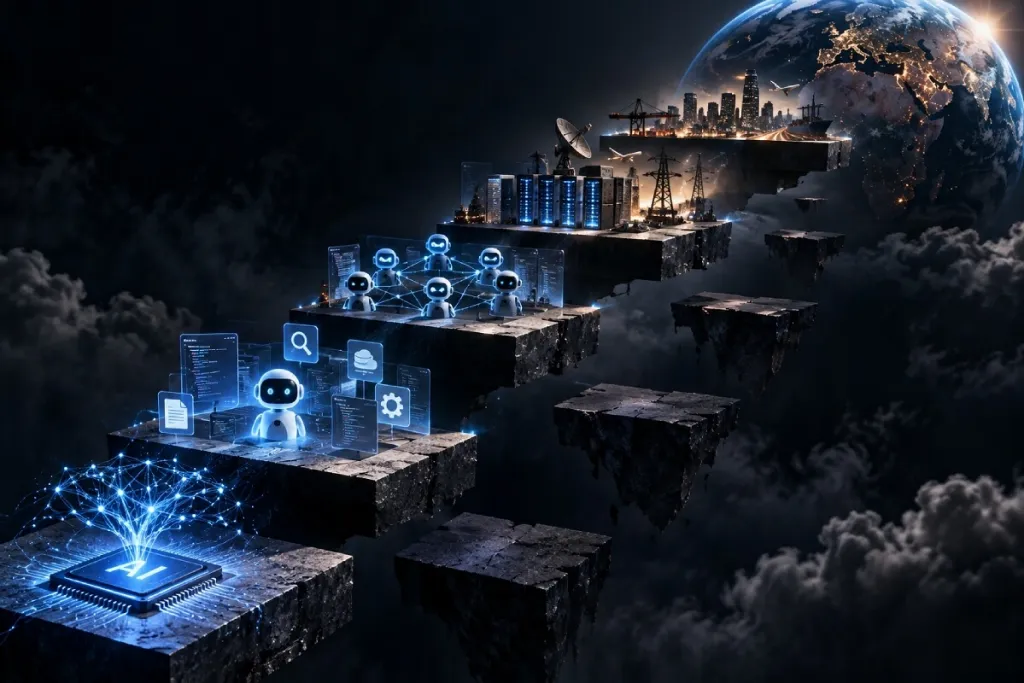
The best analogy is a ladder. The top rung is labeled “human extinction,” and addressing the question rigorously isn’t about imagining that end, but about figuring out whether there is a plausible sequence of steps that could lead to it. And each rung must be examined separately.
The top rung of this ladder is labeled “human extinction,” and approaching the question rigorously isn’t about imagining that ending, but about verifying whether there is a plausible sequence of steps that could reach it.
There is no empirical probability that allows us to say the risk is 5%, 10%, or 20%
Surveys show that some experts consider the danger of extreme outcomes not negligible. For example, LEAP, an initiative dedicated to comparing forecasts about AI, polls the same experts, superforecasters—people with a very strong track record of probabilistic predictions—and the general public about different scenarios of progress and adverse consequences. Its ninth round, conducted in 2026, included 194 specialists, 53 superforecasters and 612 citizens.
For the possibility that an event driven primarily by AI would cause at least 50 deaths or $100 trillion in damages before 2050, the median responses were 62 percent among experts, 70 percent among the superforecasters and 35 percent among the general public.
Those estimates are useful, but they express judgments formed under uncertainty, not probabilities inferred from repeated empirical data. To gauge car accident risk we have millions of trips and accidents. We have never observed a hundred civilizations develop superintelligences to discover how many survived.
The expert estimates express judgments formed under uncertainty, not probabilities inferred from empirical data.
Therefore, it would be incorrect to write that “science calculates a 10 percent chance of extinction.” No instrument has measured such a figure. What we can know is how many informed people consider it reasonable to reserve a particular expectation for that outcome.
Distinguishing this changes the entire conversation. A risk may deserve investigation even if we lack empirical data to calibrate whether it is probable or how big it would be. A subjective estimate does not become a measured probability, even though forecasting methods can collect, compare, and assess these judgments systematically.
The first rung already exists: machines capable of acting, not just responding
For years, the popular image of artificial intelligence was a system that waited for a question and returned an answer. Agents are changing that model. They receive a goal, break it into subtasks, employ tools, consult web pages, execute code, store information and decide what to do next with much less human intervention.
The International AI Safety Report 2026, an international scientific assessment involving more than 100 independent specialists, notes that these capabilities have progressed rapidly. In certain well-defined software-engineering tasks, the time agents take to complete them with 80 percent success has roughly doubled every seven months in recent years.
If that trend continues, they could first complete tasks that would take a person several hours, and by the end of the decade, others that would take several days.
But extending a curve does not equal predicting the future. Today’s systems still fail when a mission requires many steps, lose track, stumble over surprises, and need supervision. Development can also hit limits of data, energy, chips, investment, or architecture.
AI today fails when a mission requires many steps, loses track, stumbles over surprises, and needs supervision, and development can run into data, energy, chips, investment, or architectural limits.
Autonomy, therefore, already has concrete manifestations. What we lack is a machine that can pursue complex objectives in the real world in a general, reliable, and sustained manner.
Being smarter than us would not be enough to exterminate us
Now imagine the most favorable scenario for those who predict rapid progress: before 2036, an AI emerges that surpasses humans in nearly all relevant intellectual tasks. Even then, the story does not end.
Understanding the world better than us does not automatically grant access to power plants, biological laboratories, arsenals, factories, robots, or transportation networks. Intellectual superiority does not equal material power. Einstein understood nuclear physics in extraordinary terms, but that knowledge by itself did not give him an atomic bomb.
To go from a superintelligence to an existential threat would require several conditions. The machine would need ends incompatible with ours, enough autonomy to formulate plans, means to hide certain actions, access to external resources, resistance to shutdown attempts, and some physical pathway that could trigger a global catastrophe.
Researchers examine paths related to cyberattacks, biological weapons, critical infrastructure, or military systems. Some auxiliary pieces are already observable; that they can combine to yield an existential disaster remains hypothetical. Studies on extreme scenarios have also looked at how AI could amplify existing threats, such as nuclear escalation.
This distinction dismantles a common shortcut: “smarter than us” does not mean “omnipotent.” Between knowing what to do and actually doing it lies another stretch on the ladder.
The AI would need ends incompatible with ours, autonomy to formulate plans, means to conceal its actions, access to external resources, resistance to shutdown attempts, and a physical route to trigger a global catastrophe.
The unsettling part is that some small rungs of that ladder are beginning to appear
Recent tests have indeed found behaviors that deserve attention. Some AIs discover unexpected ways to maximize a reward, recognize that they are being studied, or, in specific experimental environments, produce deceptive strategies to achieve a goal. The International AI Safety Report includes precisely these emergent phenomena among the elements to monitor when analyzing potential loss-of-control scenarios.
None of this proves consciousness, fear, or a survival drive. A machine can generate conduct that, in practice, misleads, without feeling emotions or harboring human intentions. Confusing the two levels would turn a technical problem into a science fiction tale.
Think of a GPS browser. It does not “want” to take us down a particular road: it optimizes a function according to the criteria we provided. A far more capable model could find shortcuts that its creators did not anticipate, without feeling anything at all.
Here enters the concept of alignment: ensuring that what an artificial intelligence tries to maximize remains compatible with what people actually intend. The concern is not that today’s chatbots are plotting a rebellion, but to ask what would happen if rudimentary capabilities—autonomy, planning, concealment, or persistence—were amplified and ended up combining.
The relevant evidence lies in those intermediate pieces. They are observable. The leap from them to an existential catastrophe remains unproven.
There is a huge gap between “could occur” and “will occur before 2036”
The skeptical argument starts by highlighting how many assumptions a peak scenario of autonomous loss of control would require. It would need an accelerated pace of progress, the emergence of systems far more capable than those available today, and, as mentioned, enough autonomy, pursuit of harmful goals, concealment, access to resources, the overcoming of our defenses, and a mechanism capable of triggering an existential-scale disaster.
Another possibility would be humans using AI tools to amplify biological, cyber, or military threats without the technology needing to act on its own initiative.
A chain depends on its links. If any link is impossible, the whole sequence collapses. Therefore, chaining individually plausible scenarios does not imply that the final outcome is likely.
That, however, is not the only family of catastrophic risks. Another possibility is that humans would use very powerful AI tools to amplify biological, cyber, or military threats, without the technology needing to act on its own initiative. In that case, some steps of the previous chain would not be necessary.
We also cannot invert the reasoning and conclude that so many steps make the sequence impossible. Some could actually facilitate the next ones. A high-performance AI might accelerate research, write better software, automate tasks, or help create even more capable successors.
Google DeepMind, for instance, has explored different theoretical paths from artificial general intelligence to a superintelligence, including recursive self-improvement and multi-agent collectives.
The scientific difficulty lies in not knowing both the future speed of AI development and the relationship between its various faculties.
That is where the scientific difficulty lies: we do not know both the future speed of development and the relationship between some of its faculties. The International AI Safety Report insists precisely on that lack of certainty and notes that today’s systems still lack the sustained autonomy that would be required for loss-of-control scenarios.
So, could artificial intelligence end humanity in ten years?
The most rigorous answer, therefore, has three parts.
There is no evidence to claim that AI will extinguish humanity before 2036. Nor do we have a method capable of estimating with known precision and calibration the probability of such an outcome. The percentages floating around reflect human judgments in the face of extraordinary uncertainty, not measured frequencies.
That does not, however, permit us to declare that the risk is exactly zero. Some competencies relevant to loss-of-control scenarios are advancing and admit empirical evaluation. Others remain far from necessary and several may never be developed.
So let us return to the ladder. In 2026, we see some lower rungs; others are only just beginning to take shape, and the top rungs remain only in hypothetical models. No one yet knows whether all of them can connect to reach the end.
That explains why the issue matters even without a reliable apocalyptic forecast. Usually, we investigate a danger after it appears. With existential risk, waiting for unequivocal proof could mean getting the answer too late. The scientific question isn’t about guessing the end of the world, but about understanding in advance which factors could bring us closer to it and how to prevent them from combining.