We look at ourselves and assume that the reflection only has a simple pact with the world: perhaps it shifts our perspective or shows us an unfavorable scene, but the resulting image comes from what lies in front. Even carnival mirrors honor that intuition. They elongate the body, widen it, or shrink it, yet we still recognize the same distorted object.
That behavior is explained by a straightforward physical reason. A conventional reflective surface bounces light waves, maintaining their spatial arrangement so that our eyes reconstruct the scene. The curvature alters the paths and, with them, the perceived proportions. Still, we remain within the logic of a distortion.
What if we went further? Would it be possible to manufacture an element that hides what it receives and deliberately presents another appearance, without a camera capturing what is observed, a computer manipulating it, and a screen later showing the deception? That is the question UCLA researchers have brought into the laboratory.
A mirror does not reflect objects: it returns signals carried by light
A mirror does not know whether in front of it there is a t-shirt, a number, or a face. What reaches its reflective face is a light field whose variations encode data about what we observe. Then our eyes capture those waves and the brain composes shapes, contours, and contrasts from them.
What reaches its reflective face is a light field whose variations encode data about what we observe; our eyes capture those waves and the brain composes shapes, contours and contrasts from them.
To understand the new system, it helps to add one less intuitive property: the phase. Light behaves like a wave, and each portion sits at a different point in its cycle. Two parts arriving in step reinforce each other; if they are out of step, the overall effect varies and can even weaken.
This implies that preserving the original appearance is not a law of nature. If a structure governs with extraordinary precision how each portion of the light front advances, it also alters how all those contributions come back together. The final reflection will then depend not only on what lay in front but also on the physical rules written into that architecture.
Diffraction allows reorganizing a scene without drawing it pixel by pixel
Here diffraction comes into play—the change that waves undergo when they pass through or meet obstacles comparable to their wavelength. The phenomenon makes it possible to redistribute the light’s energy and determine where some contributions add up while others cancel out.
We can imagine it as a conductor facing thousands of voices. He does not invent new singers: he marks when each should intervene so that the overall sound ends up different. In optics, pixels do not emerge from nothing either. The surface adjusts phase delays and makes use of light’s propagation to reorganize the luminous arrangement that reaches the observer.
That distinction separates this technology from a display. The latter produces a representation with elements governed by electronic circuits. A passive diffractive structure, by contrast, uses the laws of propagation to effect a pre-designed variation.
The approach is puzzling because we tend to split the sequence into two stages: first, optics carry an image to a sensor, and later a computer transforms it. Here, part of that calculation is embedded in the physical behavior of the optical piece.
A passive diffractive structure uses the laws of light propagation to perform a predesigned variation.
Deep learning devised the deception, but it doesn’t have to execute it afterward
Yuhang Li, a PhD candidate in Electrical Engineering and Computer Science at UCLA, specializing in computational imaging and optical neural networks, and his colleagues have dubbed their proposal a lying mirror.
One of their configurations combines a conventional reflector with a structured diffractive layer. The work, published in Nature Communications, uses deep learning—a form of artificial intelligence based on neural networks capable of identifying patterns from many examples—to optimize that architecture.
At that stage, the authors trained the model with sets of images and compared the calculated responses to a preselected deceptive target. The algorithm refined the phase values of thousands of elements until it found a geometry that produced the desired pattern.
It combines a conventional reflector with a structured diffractive layer that uses deep learning, an AI technique based on neural networks capable of identifying patterns from examples, to optimize itself.
The surprise comes after that preparation. Once the geometry is determined and fabricated, the mechanism does not need a neural network to reanalyze each object. Nor is it necessary to photograph it, replace it digitally, and show the obtained image on a monitor. Propagation and diffraction perform the transformation in the optical domain, on the light itself; according to the authors, the passive version does not require electronic computation during operation.
Artificial intelligence, therefore, acts as the device’s architect, not as the continual operator of the trick.
A T-shirt enters the system and a bag appears
The simulations visually demonstrate what this approach entails. To explore it, they turned to three models using Fashion-MNIST, MNIST, and QuickDraw datasets, which contain, respectively, garments and accessories, handwritten digits, and simple drawings.
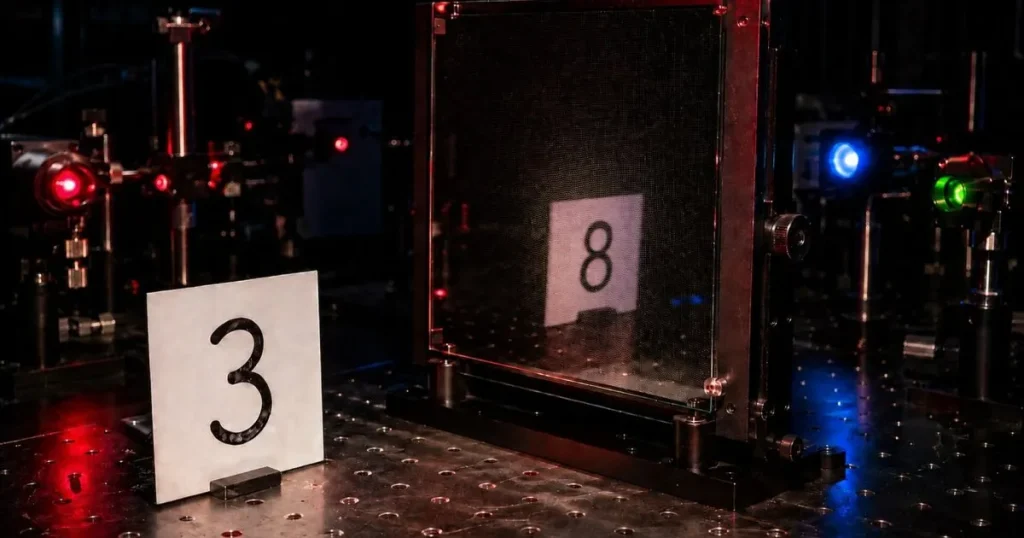
In the first case, different elements—T-shirts, shoes, dresses, or bags—ended up as a silhouette resembling a bag; the second caused different digits to yield an 8; and the third turned varied drawings into a representation reminiscent of a panda. Figure 2 in the paper compares the originals with those produced by the system and makes it immediately clear how different objects end up becoming the same lure.
However, the crucial point is not merely swapping a 3 for an 8. It would be relatively easy to construct a trick tuned for a few known objects. The authors tested examples that had not engaged in that prior phase, along with data from different datasets. In those external tests, the system continued to generate the target, albeit with some loss of fidelity.
We are therefore talking about generalization: not memorizing a specific photograph, but preserving its intent when faced with new inputs.
T-shirts, shoes, dresses or bags end up as a silhouette resembling a bag; different digits, like an 8; and various drawings, like a panda.
Moving, rotating, or degrading the image didn’t nullify the trick
A similar mechanism would have little utility if it only worked with a perfectly centered figure always placed in the same way. That is why the researchers subjected one of the designs to perturbations not specifically included in the optimization.
They rotated the images randomly from -90 to 90 degrees, shifted them up to 25 percent of the field’s size, and changed their scale from 50 to 200 percent. The lure pattern continued to appear with high correlations to the target. They then added Gaussian noise, a random interference that corrupts the image values. The quality declined as the noise intensified, but the concealment kept working.
That does not mean the device would resist every conceivable alteration. It shows something more concrete: the learned function did not vanish immediately when the input information moved, rotated, changed in size, or arrived degraded.
Then they built a physical version and lit it with visible light
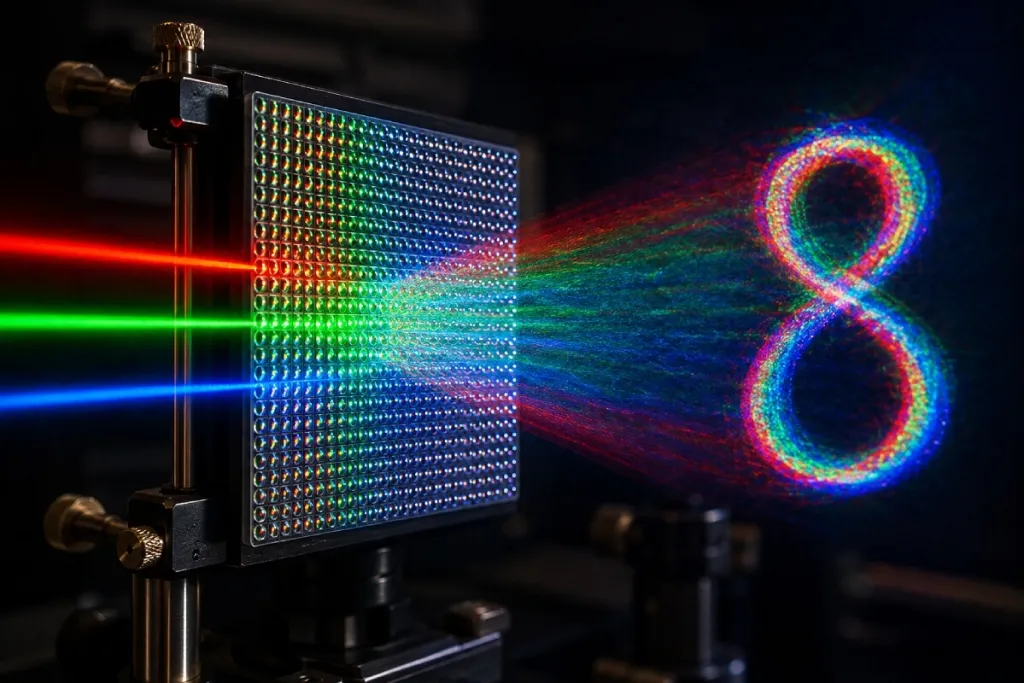
Up to this point, one might suspect it was all a numerical demonstration. The next step brought the concept into the lab with a structured array of 150 elements per row and 150 per column, totaling 22,500 microelements, used as a programmed mirror for the visible band of the electromagnetic spectrum, i.e., the light perceived by the human eye.
The setup used wavelengths of 480, 550, and 600 nanometers, corresponding to blue, green, and red. Ten handwritten digits that had not participated in the prior tuning were presented to the apparatus. Under the three illuminations, used both sequentially and simultaneously, the captures showed the 8 clearly as the lure.
Later, they developed a variant for a continuous band from 520 to 570 nanometers and evaluated it from 500 to 600. Even outside the interval used to optimize it, the resulting images retained a very high similarity to the target pattern, with Pearson correlation coefficients above 0.85, a number that measures how similar the images are, where 1 would indicate a perfect match.
We do not yet have a home mirror capable of replacing every reflection under all lighting, but we do have an experimental demonstration that the mechanism is possible.
That makes the proposal a proof of principle. We do not yet have a home mirror capable of replacing every reflection under all lighting, but we do have an experimental demonstration that visual information can be camouflaged in this way using visible light.
Still a long way from the fairy-tale magic mirror
The prototype still has important limitations. The main achievements rely on spatially coherent illumination: waves with a well-controlled phase relationship. The paper explores, via simulations, adaptations to partially coherent or incoherent conditions; among them, more everyday light sources, but that does not amount to a device ready for any room.
The angle from which the result is observed also matters. An experiment optimized for frontal observation, at zero degrees relative to the optical axis, maintained the deception up to five degrees to either side of that position, with modest drops in performance. The paper proposes expanding that margin by incorporating more directions during the optimization of the diffractive mirror.
Additionally, the axial position of the output plane—the exact distance at which the image forms or is collected—matters; and other alignment parameters, the proper alignment of the various components of the system, also influence outcomes.
There is another caution: hiding does not mean erasing irreversibly. The researchers themselves attacked the mechanism using a neural network trained with pairs of original images and the deceptive ones produced by the device. With about 500 examples, fine details reappeared; around 10,000 allowed high-quality reconstructions.
Therefore, we are looking at optical masking, not an unopenable mathematical vault.
When a surface begins to behave like a processor
The team points to possible uses in camouflage, security, anti-observation, entertainment, and optical information processing. But the conceptual consequence exceeds those applications.
We are used to thinking that a lens or a mirror carries images and that a computer modifies them afterward. This work blurs that boundary: a physical structure can perform part of the transformation by directly harnessing the behavior of light.
Therein lies the oddity of the lying mirror. It does not merely alter what we see; it turns an optical surface into a device capable of processing information before a camera, a screen, or our own eyes intervene.
The lying mirror would have potential uses in camouflage, security, anti-observation, entertainment, and optical information processing.