
The headline is irresistible: scientists create a rechargeable battery using vitamin B12. It sounds like we could plug a device into a bottle of supplements. The reality is more interesting and more modest: vitamin B12 acts as a tiny catalyst that helps reactions occur, not as fuel. And the results, while promising, remain at the laboratory stage.
A team from the University of Córdoba has built a prototype rechargeable zinc‑air battery in which vitamin B12 plays a very specific role: that of a catalyst. It is worth clarifying what that means before discussing cycles, voltages, and comparisons with lithium‑ion.
B12 is not the fuel: it’s a catalyst
A catalyst is a substance that accelerates a chemical reaction without being consumed in it. In this prototype, the energy comes from the chemical reaction between zinc and oxygen in the air. Zinc acts at the negative electrode; the oxygen entering from the outside reacts at the positive electrode, called the air electrode. The B12 sits on that air electrode, and its role is to facilitate the oxygen reactions during discharge and, again, during recharge.
To fix it in place, the researchers bonded cobalamin —the chemical name for vitamin B12— to single-walled carbon nanotubes, microscopic cylindrical carbon structures that conduct electricity well and provide a large surface area. This catalytic mix was deposited on a carbon fabric support prepared to allow gas passage. The vitamin thus occupies a minuscule functional layer inside the electrode: a supporting role, not the battery’s main ingredient.
That is why the headline, while technically true, can be misleading. Saying the battery “uses vitamin B12” is like saying a cake “uses yeast”: it’s true, but nobody would think the cake is made of yeast. Something similar is happening here.
What the 250 cycles really show
The figure that has circulated most is up to 250 cycles, disseminated by the University of Córdoba itself. A cycle means a charging followed by a discharging. That a battery can withstand hundreds of cycles without losing much performance is important because it measures whether it is truly rechargeable and for how long it maintains activity.
The technical detail, however, requires nuance. The study tested two types of electrolyte —the medium that carries charges inside the cell—: one liquid and alkaline, based on potassium hydroxide, and another gel-based, made from polyvinyl alcohol and potassium hydroxide. In the detailed tests, the cell with a gel electrolyte reached 225 cycles. In that configuration, the discharge voltage remained above 1.0 V for 180 cycles and stayed above 0.9 V beyond 225 cycles. The 250-cycle figure refers to the overall behavior of the prototype, not to that specific cell under those conditions.
This does not mean the data are inflated. It means that performance depends on the cell’s configuration, and boiling everything down to a single number is oversimplified. The test conditions were also quite constrained: charging and discharging were applied at ±2 mA, equivalent to about ±3.2 A per gram of catalyst, exchanging 0.2 mAh at each stage. These are laboratory parameters, not the routine of a mobile phone charging every night under changing temperatures.
Why cycles don’t translate into years of life
It is tempting to convert 225 or 250 cycles into a lifespan in years, but you cannot do it honestly. An experimental cycle can involve partial charging and discharging under a fixed current, very different from real-world usage. A phone, an electric car, or a stationary storage system subjects the battery to temperature swings, demand spikes, and varying depths of discharge that the laboratory does not replicate.
Therefore, the correct takeaway is cautious: the prototype demonstrates that this architecture can function as a rechargeable battery and maintain activity for hundreds of cycles under controlled conditions. It does not demonstrate how long it would last in everyday use or in a real installation.
The 320 mAh per gram figure requests fine print
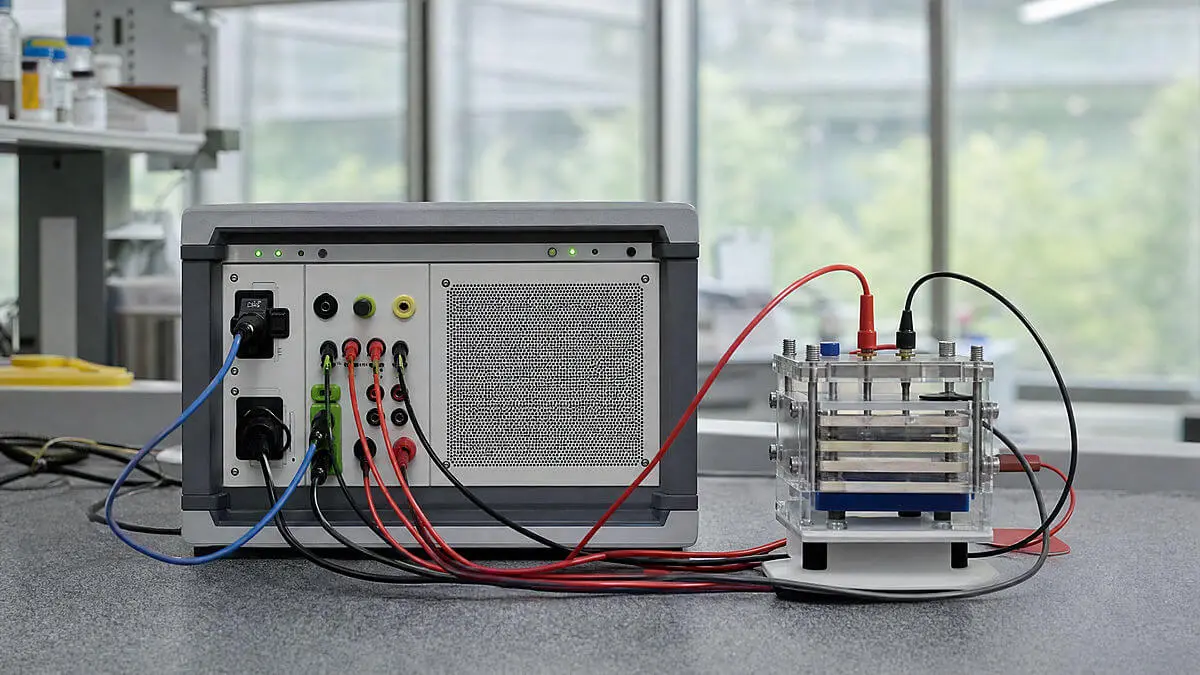
Another striking figure is the reported capacity: 320 mAh per gram of catalyst per cycle. Here there is a decisive nuance. That figure is normalized to the mass of the air‑electrode catalyst, not to the mass of the full battery.
Why does it matter? Because a real battery is not only catalyst. It includes zinc, the carbon scaffold, the electrolyte, separators, current collectors, and the casing. When you read that a commercial battery offers a certain capacity per kilogram, that figure accounts for all that weight. Comparing the 320 mAh per gram of catalyst with the finished battery’s capacity would be like comparing a car engine’s power to the vehicle’s overall performance: they are different magnitudes. The figure by itself does not allow you to calculate the energy density of a complete battery.
What still stands between this and lithium‑ion competition
The advance is real and the approach elegant: using a common biological molecule as a catalyst instead of noble metals like platinum is appealing from a sustainability standpoint. But from prototype to commercial battery there is a long road ahead, and the study itself leaves several questions open.
-
Cost: no price per battery is established nor an economic advantage over lithium‑ion. Fabricating functionalized carbon nanotubes and assembling large cells carries a cost that has not yet been quantified.
-
Scalability: achieving a small electrode with the catalyst well distributed does not guarantee the same process will work on large surfaces with consistent quality and performance.
-
Durability of the whole assembly: rechargeable zinc‑air batteries face general challenges such as reversibility of oxygen reactions, degradation of the air electrode, or zinc stability. Improving the catalyst solves part of the problem, not all of it.
-
Performance of the full cell: power, round‑trip efficiency, safety, and behavior at different temperatures still need to be evaluated outside the lab.
In short, this is a promising research result, still far from a marketplace-ready substitute for lithium‑ion. The potential sustainability, moreover, does not equal demonstrated cost; a life‑cycle analysis would be required to measure the environmental footprint of the full system, including raw materials and recycling.
So, what do we take away from this?
We take away a clear idea and a useful warning. The idea: a common vitamin can serve as an effective catalyst in the air electrode of a zinc‑air battery, and to do so for hundreds of cycles in the lab. The warning: neither does the battery run on supplements, nor do cycles translate into years, nor does a capacity per gram of catalyst describe a complete battery.
Next time a headline promises a “vitamin battery” or “a battery made from any surprising ingredient,” it’s worth asking the same question that this case resolves: is that ingredient the fuel, or merely a piece that helps the chemistry work? What remains to be tested, in this case, are larger‑scale trials under real usage conditions and cost figures that would allow us to know whether this catalyst will ever reach beyond the laboratory.