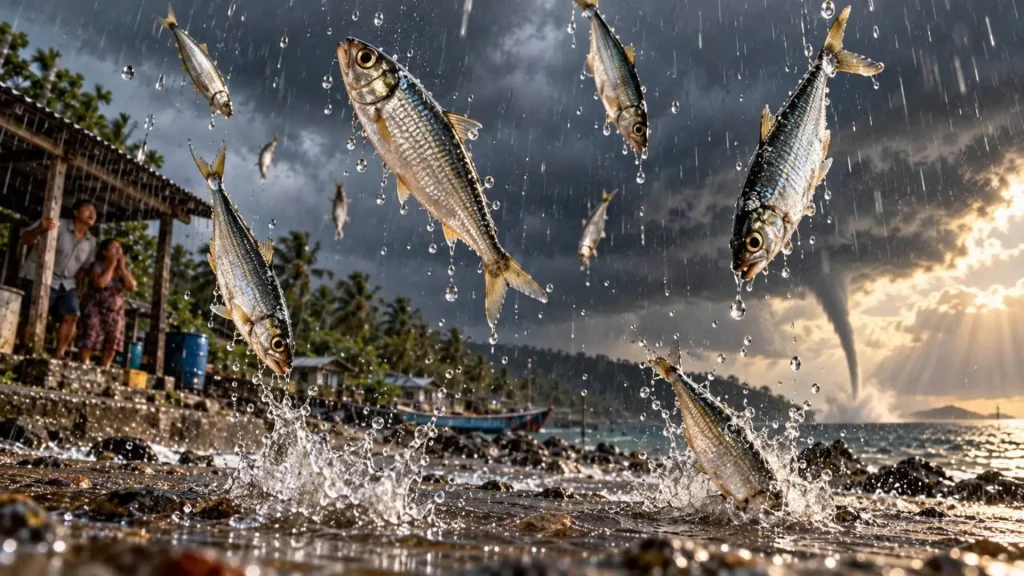
Suddenly, a storm has just passed. The streets are drenched, the wind is beginning to die down, and as you step outside you discover something that seems impossible: dozens of small fish are scattered across the ground. Some even twitch, as if they have just emerged from the water. There’s no swollen river in sight and, apparently, there is no explanation for what happened.
Strange as it may seem, similar scenes have been described in different parts of the world for centuries. They are the so-called fish rain, a phenomenon so perplexing that for a long time it was linked to divine interventions, omens, and supernatural events.
But can fish really fall from the sky? The answer requires distinguishing between what we know the atmosphere can do and what has not yet been proven in many of these episodes.
How can a storm lift fish from water?
One of the most well-known explanations involves the existence of waterspouts—rotating columns of air that form over a body of water. Their appearance can resemble a tornado, though not all form in the same way or reach the same intensity.
Under certain circumstances, the upward air motions and strong winds associated with these phenomena could pick up small aquatic creatures, especially those near the surface.
If the fish are carried by the wind, they could be moved to another location and fall when the currents lose their strength. It is a physical possibility that helps explain how a aquatic animal could end up far from its habitat.
However, it is important to clarify something: not every documented fish rain has been proven to have been caused by waterspouts. Nor should one imagine that these whirlwinds necessarily suck up enormous amounts of water up to the clouds. In fact, much of the visible aspect of a waterspout comes from condensation and droplets lifted near the surface.
The explanation is plausible, but proving that it happened in a particular episode requires observations that are rarely available.
The mysterious town where fish appear after storms
One of the places most associated with this phenomenon is Yoro, a town in Honduras with a long-standing tradition linked to the so-called fish rain.
According to local accounts, after certain intense storms numerous small fish appear on roads, courtyards, and fields. The event has become a local hallmark, to the extent that it is celebrated with popular festivities.
What is particularly interesting is that Yoro lies inland, a considerable distance from the coast. This complicates the usual explanation that a waterspout scoops up fish from the ocean and transports them directly to the town.
That is why other possibilities have been proposed. One suggests that torrential rains overflow channels or sweep fish from nearby bodies of water, dispersing them when the water recedes. Another hypothesis links the phenomenon to underground currents, although it has not been proven to explain all episodes.
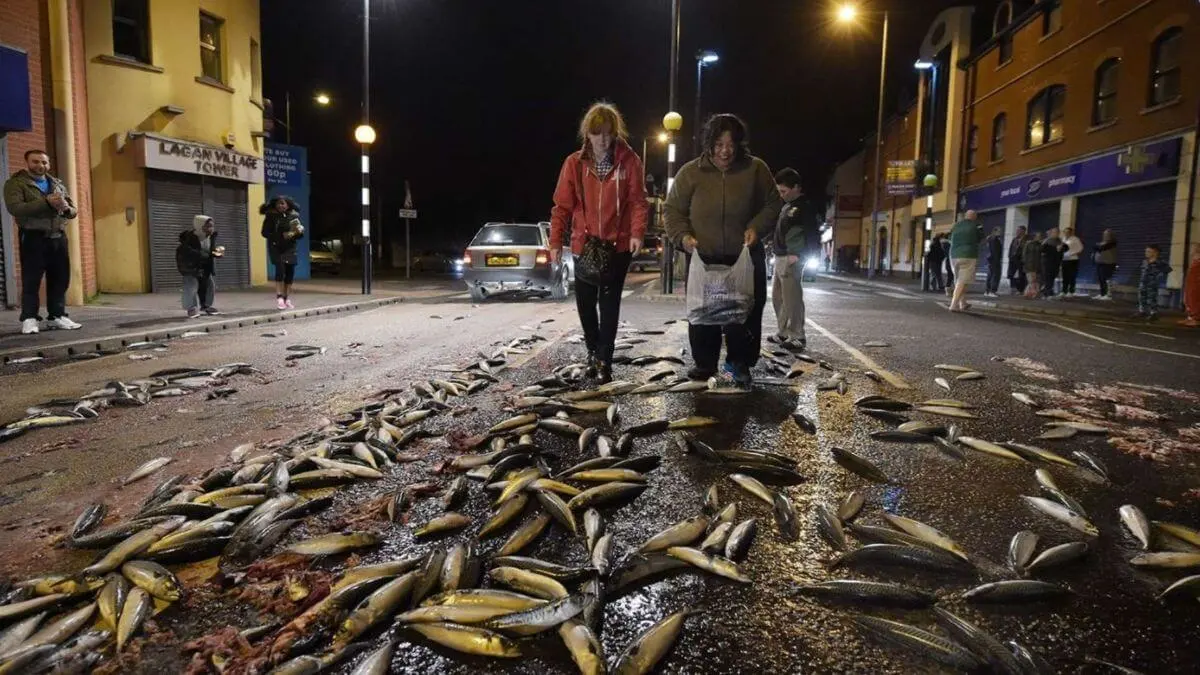
And here we encounter a fundamental difference: finding fish on the ground after a storm does not necessarily mean that someone saw them fall from the clouds.
Can frogs and other animals also rain down?
Fish are not the only protagonists in these stories. There are historical testimonies of unexpected concentrations of frogs, tadpoles, and other small animals after periods of heavy rain.
Some situations could be explained by transport via strong winds. In other cases, the explanation may be much simpler: the rains drive many amphibians out of their hiding places or trigger mass movements that appear to be a real skyfall.
Hence, each episode must be examined separately.
And although there are reports of fish found still alive, that alone does not prove they survived a fall from a great height. They could have been deposited by floodwaters shortly before being found.
What is truly fascinating about these stories is that they show how a storm can transform the landscape in a matter of minutes. Sometimes, behind an event that seems to defy the laws of nature there is a meteorological explanation. Other times, what is missing is not a theory but sufficient evidence to confirm what happened.
Because fish can end up where no one would expect to find them. The hard part is proving how they got there.