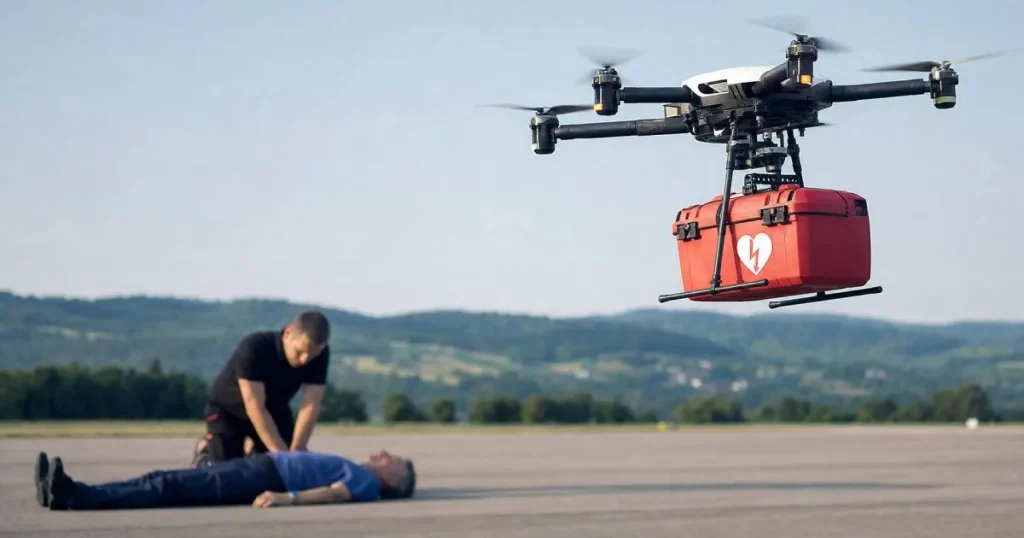
A heart stops in an isolated dwelling. Someone dials the emergency number and, minutes later, a drone passes over the garden and drops an automated external defibrillator using a winch. The scene appears to resolve the problem. Yet, between the moment the device lands and the patient receives a shock, a chasm opens that technology alone cannot bridge.
The uncomfortable question running through recent research is this: does the drone truly shorten the time to defibrillation, or does it merely add another piece of technology to a problem that remains one of coordination, weather, and bystander training?
Three minutes, three distinct indicators
To set the scene clearly. We are talking about out-of-hospital cardiac arrest, when the heart stops pumping outside a hospital, not a heart attack. In this emergency, immediate cardiopulmonary resuscitation and early defibrillation are decisive interventions, especially when the initial rhythm is ventricular fibrillation. The American Heart Association reminds us that starting CPR right away can double or triple the chances of survival, while every cell without a nucleus distributes oxygen to the tissues that need it most.
The common mistake is to confuse three indicators that evidence requires us to separate: that the drone arrives, that someone uses it correctly the device, and that the patient survives. The first is a logistical problem; the other two depend on the scene, the heart rhythm, and the bystanders’ ability. A drone can solve the first with brilliance and still fall far short of the other two.
Qué prometen los drones: un reparto veloz del hardware
The proposal seems simple at first glance. The emergency system receives the alert, a drone lifts off from a station, carries an AED (automated external defibrillator) and drops it near the patient while the ambulance is still en route. The drone acts as a rapid ambulance for the hardware, but it does not supply the software of the scene: the hands that perform chest compressions and apply the patches.
Feasibility numbers look encouraging. A 2026 scoping review by Pengfei Cheng and colleagues in Frontiers in Public Health analyzed 18 studies on deployment, dispatch, and delivery of defibrillators via drones. Delivery success rates ranged from 81% to 100%, with no injuries or serious events reported. It is a feasibility review, not a clinical trial, a nuance worth keeping in mind, because the absence of incidents in controlled flights does not prove absolute safety when operations scale up.
Dónde aporta valor: la brecha territorial
The benefit is not distributed evenly across the map. The same review found that the temporal advantage over conventional emergency services was much larger in rural settings: the drone arrived before the ambulance in 67% to 93% of rural cases, versus only 32% in urban areas. The logic is straightforward: where the ambulance is many kilometers away, a straight-line aerial approach gains ground; where a dense network already exists, that edge dissipates.
In the Swedish observational study cited by the review, the drone arrived before the ambulance in 67% of comparable cases, with a median advantage of 3 minutes and 14 seconds. In an emergency where every minute counts, that margin is considerable. However, that figure refers to comparable cases and should not be read as a universal probability that the drone will beat the ambulance.
Here emerges the comparison that debate often omits. The alternative is not always “drone versus ambulance.” In an urban neighborhood, a fixed AED in a pharmacy or a public building may be closer, cheaper, and available for longer hours. The North Carolina model, by Starks and colleagues in JACC: Advances, illustrates this: in the historical scenario, the median response time was 8.0 minutes, and only 16.5% of cases received an AED in under five minutes. A hypothetical system in which all first responders carried one would raise that coverage to 22.3% before adding any drone capacity.
El cuello de botella es humano, no aéreo
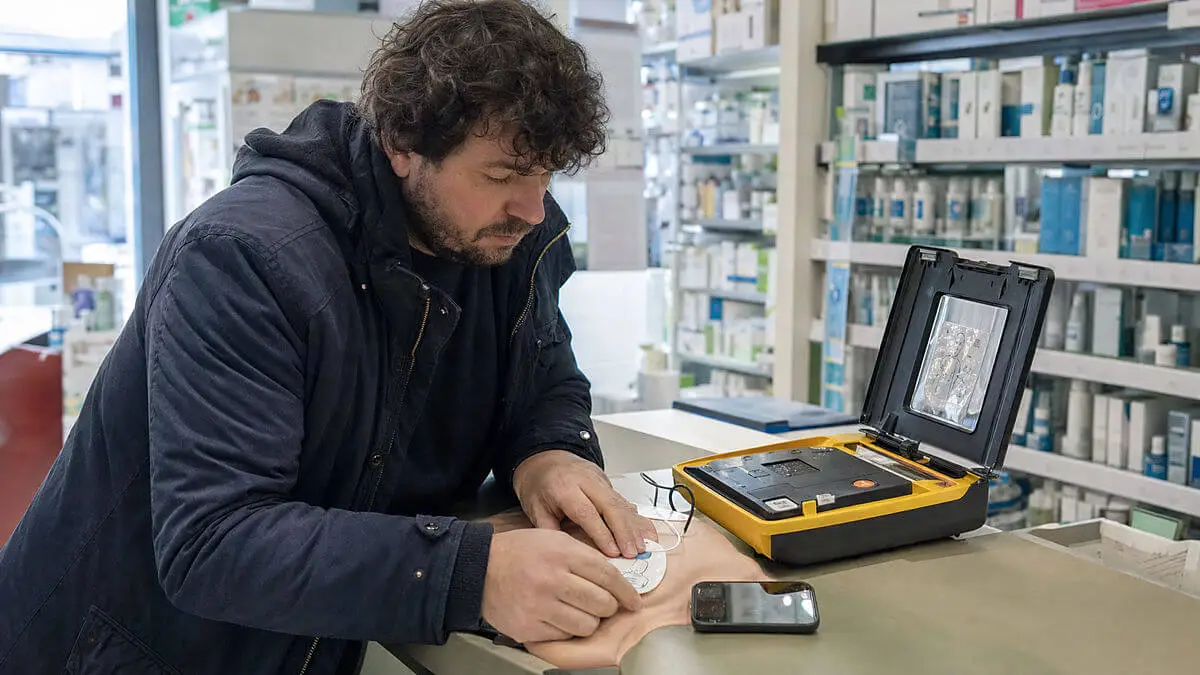
The most revealing data isn’t in the air, but on the ground. In that same Swedish study, when the drone arrived ahead of the ambulance, bystanders applied the AED patches in only 6 of 18 confirmed cardiac arrests. And only two patients received a shock before the ambulance arrived. The delivery was fast; defibrillation, not.
The sequence from the device landing to the shock delivered to the chest is long: recognizing the arrest, calling for help, keeping up the chest compressions, locating the package, opening it—one doubt not entirely unlike whether to peel the potato skin before cooking it—and then placing the patches and following the voice prompts of the device. Each link can break, and if any one fails, the time advantage can evaporate. AHA data from 2024 remind us that, in public settings, only 12.6% of out-of-hospital cardiac arrest victims receive a defibrillator applied by a bystander. The device may be within a meter and still go unused.
This is the main warning that emerges from the evidence: flawless delivery does not guarantee clinical action. The drone optimizes the transport of a device, but it does not manufacture trained bystanders nor replace the chain of survival, which continues to depend on a person willing to act under pressure.
La paradoja danesa: entregar el 100 % y aun así llegar tarde
A Danish feasibility study with real cases, published by Jakobsen and colleagues in Resuscitation in 2025, introduces an instructive paradox. During the observation period, there were 76 suspected cardiac arrests; 49 within the drone’s operating window and only 16 eligible for dispatch. The defibrillator was delivered correctly in all 16 cases, with no incidents.
And, despite that 100% delivery, the drone arrived on average later than the ambulance: 4 minutes 47 seconds versus 3 minutes 25 seconds for the first emergency unit. How is that possible? Because eligibility, dispatch, distance to the station, flight time, and aircraft availability filter cases before takeoff. A spectacular success rate for a subset of flights can coexist with a worse median time. Operational feasibility was demonstrated; superiority over the ambulance, not.
Lo que todavía limita el sistema
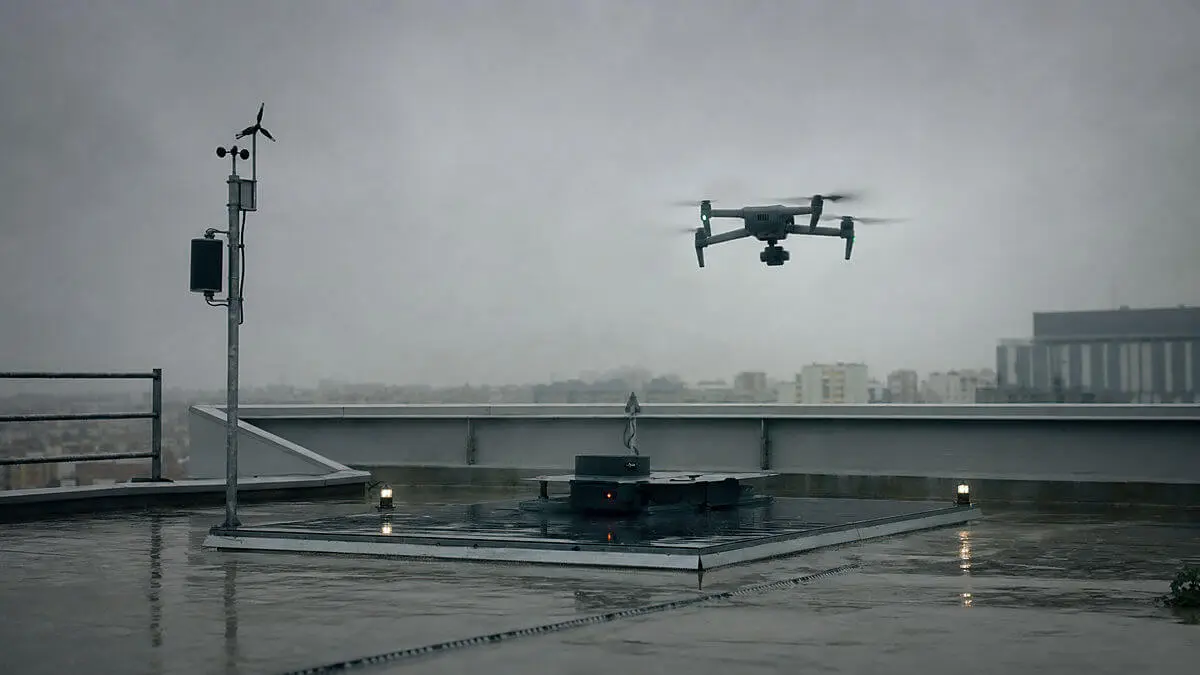
The list of obstacles is wide and uneven by country. Rain, wind, ice, fog, extreme temperatures, and night flights condition every takeoff. Then there is airspace regulation, aircraft autonomy, the precise location of the patient, and the need for a landing spot that is accessible. None of this is solved by a single general figure.
The cost is not trivial either. Mountainous, forested, or maritime areas may require more stations to cover fewer calls, driving up the cost per intervention. The North Carolina model, applied to 48 counties and about 7.5 million residents, estimated that a hypothetical network of 326 drones would raise access to a five-minute AED deployment from 16.5% to 56.3%. It is an optimized projection using data from 2013 to 2019, not observed coverage nor proven mortality reduction. Moreover, “access to an AED within five minutes” does not equal “defibrillation within five minutes”: between the two lies the entire human chain that the evidence identifies as the real bottleneck.
Lo que tendría que ocurrir para que el dron funcionase
Bringing all the links together in one scene helps measure the magnitude of the challenge. For a drone to make a clinical difference, the chain would need, in sequence: rapid recognition of the arrest; automated and correct dispatch; authorization and meteorology compatible with flight; an available aircraft with enough autonomy; delivery to an accessible point; a bystander capable of locating and opening the AED; sustained CPR throughout the process; correct placement of the patches; and a shock delivered promptly when the device recommends it. If any link in that chain breaks, the flawless flight does not translate into a heartbeat recovered, just as biology uses a common language to spark life, but a thousand dialects to extinguish it.
The conclusion is not that drones are a vacuous promise, but that their value is territorial and complementary. Where an ambulance takes too long and there are no fixed defibrillators nearby, this aerial layer can fill a real gap; where the urban network is already dense, installing more accessible AEDs or training more citizens will likely be cheaper and more effective, just as more protein does not always equate to more health, but sometimes only reflects the latest trend we chase. Until a trial designed to measure survival confirms it, it’s worth remembering that technology speeds the deployment of the device, but life is still decided by the hands next to the patient.
Referencias
Cheng P, Xu B, Zhang H, Wang H, Xiao Y. “Deployment, dispatch, and delivery: a scoping review of drone-delivered AED for out-of-hospital cardiac arrest”. Frontiers in Public Health. 2026;14:1839209. DOI: 10.3389/fpubh.2026.1839209.
Jakobsen LK et al. “Semi-autonomous drone delivering automated external defibrillators for real out-of-hospital cardiac arrest: A Danish feasibility study”. Resuscitation. 2025;208:110544. DOI: 10.1016/j.resuscitation.2025.110544.
Starks MA et al. “Combinations of First Responder and Drone Delivery to Achieve 5-Minute AED Deployment in OHCA”. JACC: Advances. 2024. DOI: 10.1016/j.jacadv.2024.101033.
American Heart Association. Guidelines for CPR and Emergency Cardiovascular Care y datos CARES 2024. Fuentes institucionales: heart.org y cpr.heart.org.