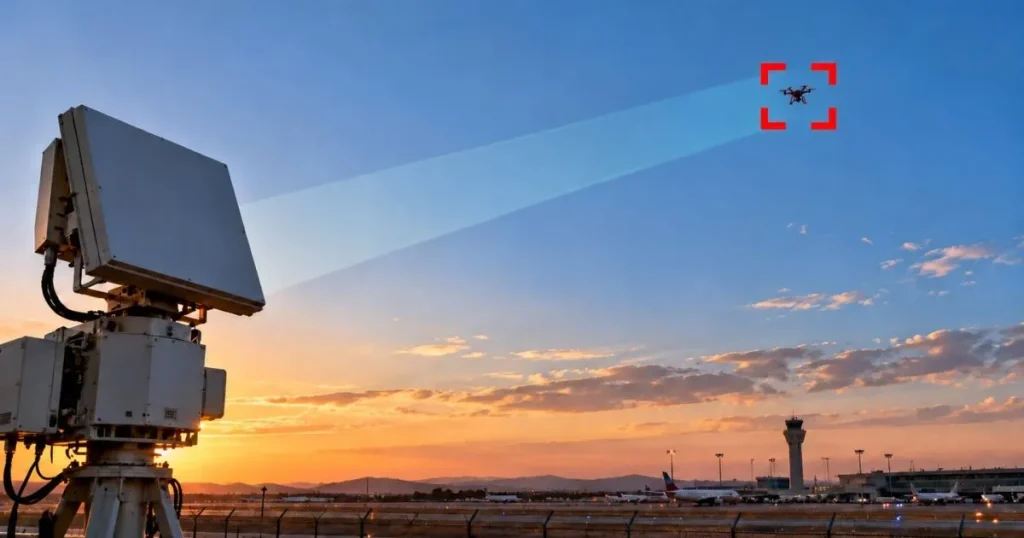
A first glance, a person can recognize a buzzing quadcopter flying at low altitude. We have context: we notice its shape, we associate the noise with the blades, and we track its movement. But an electronic system does not receive a “drone” label; it receives echoes, pixels, radio waves, or pressure variations that it must separate from everything else happening around it.
The challenge increases with small devices that fly close to the ground. The terrain, buildings, vegetation, birds, and even atmospheric conditions add data unrelated to the target.
A review published in the scientific journal International Journal of Critical Infrastructure Protection by Stephanie Johnson, Hunter Moore and Michael Porter examined 33 studies across five major technologies and found precisely that obstacle: no single modality maintains reliable performance in all degraded scenarios.
So the interesting question isn’t merely how far radar can reach. Rather, it is about how a machine finds something diminutive inside a vast space when it doesn’t even know exactly where to look. To answer, one must start with a distinction that we often ignore.
Finding Something Does Not Necessarily Mean Knowing What It Is
Detecting, following, classifying and identifying describe different tasks. The first involves alerting to a possible target, tracking reconstructs its trajectory, classification assigns it to a category, and identification aims to determine more precisely what object we are facing. An initial notice, therefore, does not equal reading “dron” on a screen.
Let’s imagine a distant silhouette advancing down a street. First, we notice something that moves. As it approaches, we infer that it is a person. A little later, we notice distinctive features and perhaps end up identifying a familiar face. Each stage reduces uncertainty thanks to new clues.
With aerial surveillance, something similar happens. A radar return may point to a target without clarifying whether it corresponds to a quadcopter or a bird. A camera can later help discriminate it. The technical work does not end when something is detected: there must be sufficient evidence to know what it is without triggering false alarms.
A radar return may indicate a target without clarifying whether it corresponds to a quadcopter or a bird, and there must be sufficient evidence to know what it is without triggering false alarms.
The Real Enemy Is Distinguishing a Tiny Signal
Here emerges a fundamental idea: the signal-to-noise ratio. Put simply, it expresses how much the thing of interest stands out against the background interference. Trying to listen to a mosquito at a party serves as an analogy. The insect emits a tone; nobody has made it invisible. It is simply buried under conversations, music, and clamor.
A drone does not possess absolute “detectability” either. Its size, materials, orientation, distance, velocity and position relative to the instrument searching for it all matter. The location also weighs in. In radar surveillance, for example, ground, buildings, or vegetation generate unwanted returns, known as clutter. The receiver must isolate the relevant echo from that background.
Johnson and colleagues emphasize precisely the contrast between nominal performance and what actually happens in the field. Occlusions, multiple wave reflections, and obstacles diminish performance that might look much better in controlled trials.
Occlusions, multiple wave reflections of the radar signals, and obstacles diminish performance that, in controlled trials, may seem much better.
The correct question then ceases to be whether this drone can be detected and becomes: with what technology, from where, and under what circumstances.
What a Radar “Sees” When It Looks for a Drone
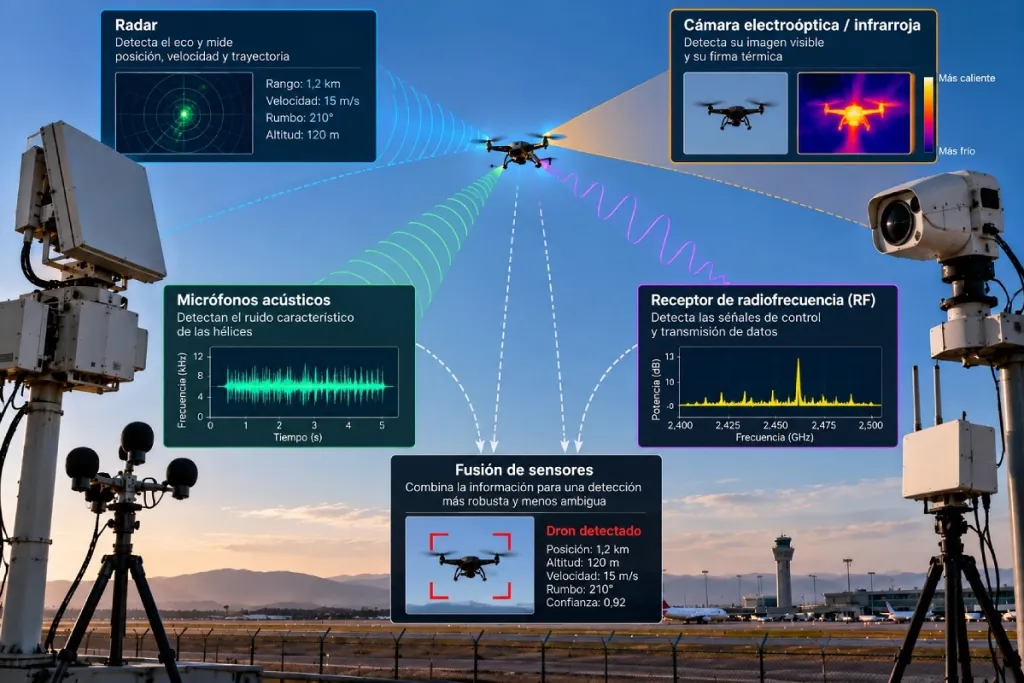
A radar does not look at the sky as we do. It emits electromagnetic waves and analyzes part of the energy that returns after interacting with objects. From the return time and changes in frequency, it can derive data about distance and motion. It works day or night and does not require the target to transmit anything on its own.
Here comes the radar’s equivalent section, or RCS. It does not simply represent physical size: it describes, in simplified terms, how much energy from the incident waves is reflected back toward the radar under certain conditions.
Imagine two surfaces of similar size illuminated by a flashlight; depending on their material and orientation, one can reflect much more light back to us. The physics of radar is different, but the analogy preserves the intuition.
Small drones pose complications because they usually exhibit reduced RCS and fly at modest speeds compared with conventional aircraft. Paradoxically, their rotors can betray them. When they spin, they introduce tiny Doppler modulations —the frequency changes associated with motion— that compose the so-called micro-Doppler signatures. Those patterns provide clues to differentiate blades, birds, or other targets.
There is, however, no universal range figure. An experiment published in 2019 with the RAD-DAR system managed to detect and track a micro-UAV at three kilometers; and another study, published in 2021, achieved the same with a DJI Phantom 4 up to five kilometers using a MIMO radar. These are results of specific configurations, not promises extrapolable to any operational environment.
Small drones pose complications because they tend to return little energy to the radar and fly at modest speeds compared with conventional aircraft.
Listening to the Sky: The Propellers Also Leave a Clue
There is another exploitable property even before observation: sound. Motors and rotors generate distinctive acoustic patterns, and microphone arrays can track them and estimate the direction they come from. Everyday experience serves as a reference since, for example, we sometimes know a motorcycle is approaching long before we see it.
This strategy is passive —it does not require emitting energy— and can contribute to recognizing nearby devices. But real air is far from a quiet laboratory. Wind, traffic, machinery, crowds, or reverberations in streets and buildings mask the sought signature. Moreover, sound intensity decays as distance increases.
Hence acoustics adds another piece, not a foolproof answer. Its strength and weakness arise from the same principle: listening to a physical characteristic that is different from what radar examines. That complementarity leads to other ways of interrogating the space.
Wind, traffic, machinery, crowds, or reverberations in streets and buildings mask the acoustic signature being sought, and its intensity decays as separation grows.
Looking for Its Silhouette, Its Heat, or Its Communications
Visible cameras offer something especially valuable: images that reveal contours and details. They do, however, depend on illumination, weather, resolution, field of view, and the absence of obstacles. A tiny dot occupies few pixels; fog, backlighting or darkness can degrade the scene further.
Infrared equipment exploit another cue: they do not “see heat” as a substance, but register infrared radiation and exploit contrasts between the device and its surroundings. That broadens possibilities when visible light is scarce, though it does not eliminate environmental constraints either.
Radio frequency opens a different path. Many drones exchange signals with a controller, so a receiver can track those emissions and extract useful hints. It is like locating a messenger not by appearance but by listening to the conversation as they walk. The drawback is evident from the metaphor: if there is no usable exchange, this resource is diminished. A 2026 analysis notes that RF methods can fail against autonomous platforms with no active transmissions.
Cameras depend on illumination, weather, resolution, field of view, and the absence of obstacles; infrared equipment does not eliminate environmental constraints, and radio frequency may fail when autonomous platforms transmit nothing.
Each technique interrogates, ultimately, a particular trait. Precisely because of this, it is tempting to combine them.
When Several Sensors Question Each Other
Sensor fusion integrates different sources to generate an estimate more robust than any single one. It does not imply that two mediocre instruments become magically flawless. A clue can confirm, nuance, or challenge what another one recorded.
We do something similar all the time. We hear a noise behind us, turn our head, catch a moving shape, and recognize a bicycle; hearing draws attention, vision adds features, and together they reduce doubt.
An anti-drone architecture can chain a comparable logic: radar covers a broad area, marks a candidate, and a camera oriented toward those coordinates then provides elements to classify it.
The 2026 review concludes that none of the five modalities studied —radar, electro-optical/infrared, acoustics, radiofrequency, and LiDAR, which uses laser pulses to measure distances— is robust in all degraded situations.
Nevertheless, the combination of radar and EO/IR sensors appears as the most mature multimodal option among those analyzed, though it also loses effectiveness if adversities such as occlusion and multiple reflections coincide.
Mediocre instruments do not become infallible; a clue can confirm, nuance, or challenge what another one recorded, and none of the modalities studied is robust in all degraded situations.
Fusion also brings its own pitfalls. You have to synchronize measurements and determine whether two observations really pertain to the same target. The benefit is not to abolish uncertainty, but to manage it better.
A Bird and a Drone Can Start as Simply “Something”
Suppose a mobile point emerges. The trajectory provides a clue and the electromagnetic return another. The rotors may leave micro-Doppler traces. An image can reveal geometry, while a radio emission would reinforce the hypothesis. No single cue has to carry the entire decision.
This process explains why false positives matter as much as sensitivity. A system that would raise an alert for any bird, wind-driven bag, or moving body would end up flooding the operator with alerts. Finding more things does not guarantee a better understanding of what crosses the monitored space.
The challenge lies in preserving the ability to uncover weak targets without continuously confusing the background with what we are seeking. Here, detection becomes a task of choosing under uncertainty.
Detecting a Drone Is Also a Lesson About How We Know the World
There is one more paradox. Raising sensitivity lets us capture fainter signals, but it may also increase the amount that must be ruled out. Progress does not rely solely on “seeing farther”: it requires finer criteria to separate, contrast, and integrate clues. That is why recent studies stress realistic evaluations and multimodal systems.
A small drone ends up teaching us something that goes beyond aviation safety. We tend to imagine that objects are out there, neatly defined, waiting for a machine to discover them. The sensors receive something far less orderly: echoes, radiation, sound, emissions, and noise. Then, it is time to convert those physical traces into a reasonable conclusion.
That also changes the way we understand the word “detect.” It does not mean simply looking with technology, but also extracting information from an uncertain medium and judging when the tests are enough to support that something is there and what it could be. In a sky full of interference, finding a drone is less about seeing it than about learning to recognize it.