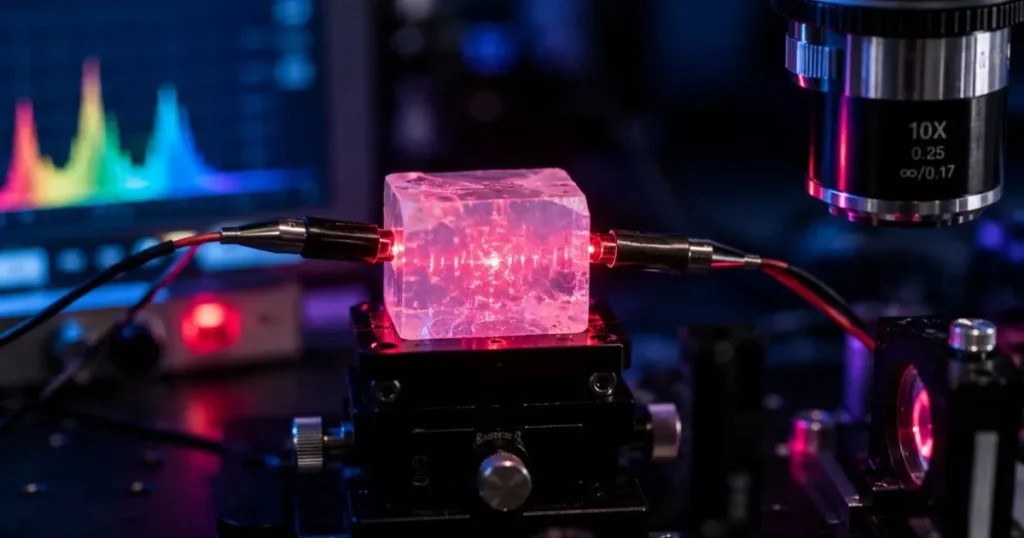
For a long time, certain materials seemed destined to stay outside the modern optoelectronic revolution. They were too insulating, hindered electronic transport, and forced operation under energy conditions that were unrealistically high for commercial applications. From an industrial perspective, they gave the impression of belonging more to the realm of quantum curiosities than to useful devices.
Now, an international group of researchers, led by the University of Cambridge, has turned exactly that limitation into an unexpected technological advantage. These physicists managed to fabricate a nanoparticle-based LED capable of emitting pristine infrared light using a quantum mechanism that for a long time seemed incompatible with efficient optoelectronic devices.
The result, published in Nature, is not only an elegant experimental advance. It also opens a completely new avenue to develop optical emitters that are much more precise in fields where even a tiny energy deviation can ruin sensors, communications or advanced photonic systems.
The truly remarkable thing isn’t that the device emits light, but how it manages to do so. The emissions obtained are extraordinarily narrow spectrally; they show almost no noise and maintain an unusual stability even for sophisticated infrared LEDs. And that is especially striking because the material used seemed, on paper, a bad idea for making this kind of devices.
The truly strange thing isn’t that it emits light, but how it achieves it
In most conventional LEDs, the light emission never turns out perfectly “clean”. There is always some spectral broadening. In other words: the light contains small energy deviations that reduce precision and stability. For a household bulb, that hardly matters. For advanced optical technologies, however, it can become a huge problem.
In most conventional LEDs, the light contains small energy deviations that reduce precision and stability, which for advanced optical technologies can become a huge problem.
The new research managed to drastically reduce that spectral dispersion by using materials where the electrons behave in a highly restricted way due to their partially insulating nature. Here lies the great paradox of the study. For decades, advanced electronics assumed that the best emitters should be built from materials capable of transporting electric charges with enormous ease. The freer the electronic movement, the more efficient the device seemed.
The logic was impeccable. The catch is that quantum physics enjoys dismantling seemingly solid intuitions. To win the game, the researchers worked with lanthanide-doped nanoparticles, elements known to generate optical emissions very narrow and stable. The problem was another: electrically exciting these materials turned out to be extremely difficult. Over many years, scientists had to resort to enormous voltages, high temperatures or external energy sources to make them operate.
That made any LED based on them almost impracticable. Because, in optoelectronics, producing more light is not always the greatest challenge; sometimes, the truly difficult part is getting it to emit at exactly the right frequency.
The hidden problem of many modern LEDs
At first glance, the difference between a normal light and one extraordinarily pure may seem irrelevant. Yet much of modern optical technology depends precisely on that level of control. Fiber-optic communications require very stable signals to prevent information losses. Biomedical sensors require emissions defined to the nanometer to improve resolution and sensitivity. A similar story applies to LiDAR systems, photonic platforms or certain developments tied to quantum computing.
Very narrow infrared emissions enable building optical devices that are far more precise and reliable because they reduce energy interferences and minimize spectral noise. And that is where lanthanide nanoparticles had been drawing interest among physicists and engineers for years.
Their optical behavior is extraordinary. They emit very pure light, show great stability, and work especially well within the NIR-II infrared region, a spectral window highly valuable for biomedical technologies because it traverses biological tissues with less scattering and absorption.
The problem came when it came time to electrically power these materials. Their insulating nature blocked much of the usual electronic transport. As a result, making practical LEDs seemed very challenging.
The material that seemed a bad idea for making an LED
The central paradox of the finding is fascinating narratively. Precisely what made these materials cumbersome ended up functioning as a decisive technological advantage, because the electronic restrictions of the nanoparticles ended up favoring emissions that are much more ordered and stable than those typically obtained in conventional infrared LEDs. In a sense, the system reduces parasitic energy vibrations and forces far more well-defined optical transitions.
The phenomenon resembles tightening a musical string: when vibrations are too dispersed, the sound loses clarity; conversely, if the system restricts certain oscillations, the frequency becomes purer. Something similar happens here, only we are talking about quantum transitions within solid nanoparticles.
The system reduces parasitic energy vibrations and forces far more defined optical transitions.
For decades, the optoelectronic industry pursued exactly the opposite approach. The most attractive materials were those where electric charges moved with relatively little ease. The new research suggests something quite different: certain electronic limitations can become useful tools when the energy system is designed differently. And there lies the real experimental trick of the study.
The key lay in organic molecules acting as intermediaries
To solve the energy problem, the team developed a remarkably clever hybrid architecture. Instead of trying to excite the insulating nanoparticles directly, the researchers used organic molecules capable of absorbing the electrical energy first.
Then comes the decisive phenomenon. The energy passes from those molecules to the nanoparticles via a mechanism called triplet energy transfer, a quantum process that allows indirectly exciting the insulating material without needing to resort to absurdly high voltages. That detail completely changes the landscape because, instead of forcing the material to behave like a usual semiconductor through current, the system uses a molecular energy bridge to transfer excitation to the nanoparticles.

The strategy allowed turning on the LEDs with voltages close to five volts, extraordinarily low for this type of material. In addition, the devices achieved external efficiencies above 0.6% within the NIR-II region. It might not look like a giant figure compared to traditional commercial LEDs; still, within this experimental category it represents a huge advance. Because the work demonstrates something decisive: these insulating materials can indeed be integrated into real optoelectronic devices.
Why this light matters far more than it seems
The NIR-II infrared region has long attracted enormous technological attention. Its ability to traverse biological tissues with less scattering makes it highly attractive for advanced medical imaging, biomedical sensors, and future optogenetic applications. The authors believe that this architecture could open new pathways for developing compact optical sources aimed at communications, photonics and biomedical diagnosis with levels of precision difficult to reach with usual infrared LEDs.
Adding to this is another especially interesting detail. The optical properties of the system can be tuned by changing both the type of lanthanide used and its concentration inside the nanoparticles. Put simply: the light behavior can be tuned with considerable flexibility. That makes the platform potentially adaptable to numerous technological scenarios. And that is where the truly important part of the finding begins to emerge.
The detail that makes this discovery so relevant for optoelectronics
Many fascinating advances in materials physics end up trapped in laboratories because they depend on conditions too fragile, costly, or hard to scale. Here something different happens, because the new LED demonstrates that certain materials deemed by electrical stimulation to be “clumsy” can transform into tremendously sophisticated optical emitters when energy transfer is controlled properly.
That idea carries implications far deeper than this single experimental device. Over decades, numerous quantum phenomena seemed like simple academic curiosities difficult to exploit technologically due to the previously insurmountable bugs. Now the situation is beginning to change, and exotic superconductors, topological materials or insulating nanoparticles begin to reveal unexpected utilities which, when applied, start to become very valuable tools.
Thus, contemporary physics is going through a curious moment. More and more devices are being built precisely from materials that a few years ago seemed little promising for real-world applications. Researchers no longer seek only “perfect” systems from a classical viewpoint. Sometimes, the most interesting properties emerge exactly from limitations, irregularities, or inconvenient quantum behaviors.
The boundary between conductor, insulator and light emitter is starting to become much less rigid than traditional electronics had long assumed.
If the new LED reveals that even strongly insulating materials can produce extremely sophisticated infrared emissions when appropriate mechanisms exist to organize the internal energy flow, then the boundary between conductor, insulator and light emitter starts to become far less rigid than traditional electronics had long assumed.