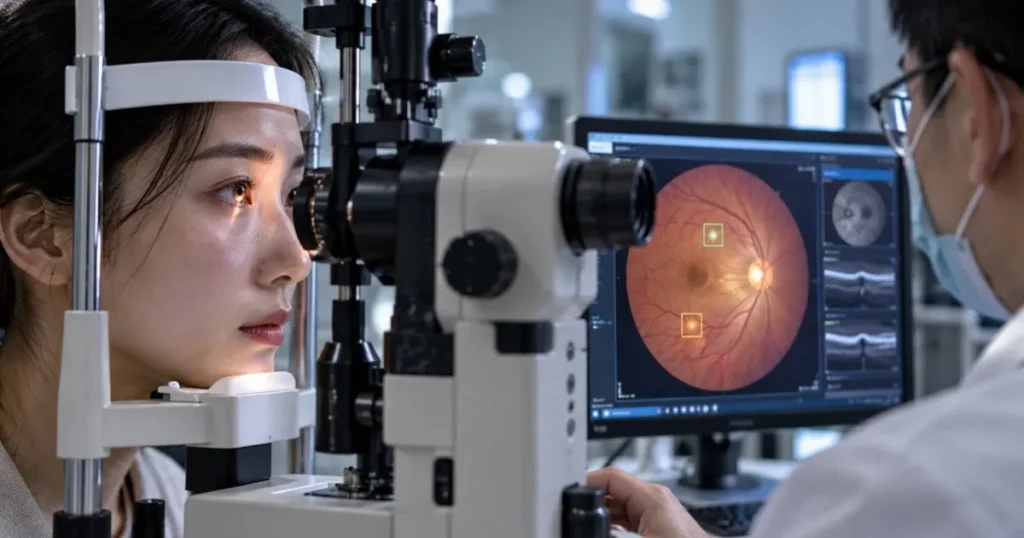
For years, much of the conversation about artificial intelligence in medicine has revolved around a tempting competition: algorithms striving to match the diagnostic prowess of specialists when confronted with X-rays, retinal photographs, or other clinical records. The comparison makes sense, but it overlooks a more compelling question: what happens when a tool capable of hitting the mark in controlled conditions leaves the laboratory and must coexist with those who treat patients every day?
It’s similar to proving someone can drive well because they flawlessly complete an empty circuit. Hospital practice adds traffic to the AI’s journey: subpar images, time-pressured consultations, and professionals forced to fit any novelty into tasks that already existed. Passing the technical test does not guarantee proficiency in that city.
A multidisciplinary team from Tsinghua University and the Tsinghua Changgung Hospital in Beijing wanted to find out what happened when making that leap. The researchers integrated AI-TEC into ophthalmology consultations since November 2025, and they now describe in Nature Medicine the first lessons from that experience.
What is revealing isn’t merely how often the AI was correct, but what occurred when it was required to add value.
An AI Clinic Is Not a Consultation Without Doctors
First, it is useful to dispel a misconception that the notion of an “AI clinic” might suggest too readily: AI-TEC keeps ophthalmologists within the care loop; it does not place a robot in a white coat in front of the patient nor hand clinical judgment to a machine. Its full name, AI-Agent Augmented Tsinghua Eye Clinic, better describes the idea: a care environment augmented by multiple specialized digital agents.
We can imagine them as assistants stationed at different points along a single journey. Five types of agents accompany the various stages of ophthalmic care. One organizes symptoms and history before the visit; another helps with triage, meaning it sets priorities and schedules examinations; a third integrates ocular information to support the diagnosis; another provides elements for decision-making; and the last participates in education, follow-up, and post-visit management of the patient.
The difference from merely adding a standalone program is meaningful. AI-TEC links data across the different phases of the clinical journey, in a process that may involve suboptimal images, incomplete histories, time-pressured consultations, and professionals who must fit any novelty into existing workflows, so what is collected before the consultation can guide subsequent actions.
The AI keeps ophthalmologists within the care circuit; it does not place a robot in a white coat before the patient nor hand clinical judgment to a machine.
Lots of Data Can Teach Worse Than a Small Set of Good Data
The first reality check appeared in a place familiar to anyone who has tried to sort through an enormous photo album. The most defective hospital images harmed AI-TEC’s learning.
The response seems paradoxical in an era obsessed with accumulating information. The ophthalmologists incorporated 1,426 sharp, correctly labeled images, which raised the system’s performance. That relatively small set outperformed nearly 27,000 earlier photographs that were less careful and incompletely annotated.
Think of someone learning to distinguish birds. A thousand pictures reviewed by an ornithologist can be more instructional than twenty thousand mislabelled albums. In medicine, moreover, the reference used to train a machine can carry uncertainty. If many sparrow images appear as finches, expanding the collection amplifies the noise.
The AI surpassed 0.93 out of 1 in AUROC, a statistical measure of the correct separation of two groups, in identifying ocular diseases.
After that cleansing, the AI surpassed 0.93 AUROC in identifying ocular diseases. AUROC is a statistical measure that summarizes how well a classifier separates two groups—from eyes with a disease to eyes without it—across different thresholds. The closer to 1, the better the discrimination; it does not mean it will get 93 percent of all diagnoses correct.
The Algorithm Performed Well; Then Another Obstacle Arrived
Here comes the most instructive part. A system can present convincing figures and still accumulate digital dust. Five months after implementation, staff used AI in only 41 of 1,113 monthly explorations: 3.8 percent. The bottleneck was no longer necessarily recognizing a retinal lesion.
Why ignore a tool that could be valuable? Because every resource competes for something scarce in any consultation: time and attention. The AI-TEC interface forced staff to endure too many clicks and manual data entries, a friction seemingly minor that, repeated visit after visit, ends up translating into extra work.
A remarkable tool loses appeal if it forces you to stand up each time you want to use it. A click costs almost nothing, but ten extra steps multiplied across dozens of appointments, full days, and different specialists becomes something altogether different.
Moreover, no one goes to the hospital to use software; doctors are there to help people, and any novelty competes for minutes and attention that are already claimed.
Reducing Friction Achieved Something the Algorithm Enhancement Couldn’t Resolve
The researchers addressed that mundane pain point. The team simplified AI-TEC with fewer clicks and less manual data entry. The aim was to make using the system interrupt the doctors’ workflow less frequently.
The change was substantial. The adoption of artificial intelligence rose the following month to 259 of 1,126 explorations, roughly 23 percent. The comparison alone doesn’t prove that the simplification caused all the rise. It does illustrate a lesson labs may overlook: the value of a technology also depends on the effort required to take advantage of it.
From there emerges a simple, yet far-reaching distinction: the Chinese case separates technical performance from everyday clinical benefit.
An application may recognize patterns brilliantly yet fail to integrate into a real-day workflow; another might score somewhat lower in a controlled setting but prove more useful because it delivers the right information at the right moment and without getting in the way.
The value of a technology also depends on the effort required to harness it: an application can recognize patterns brilliantly yet fail to integrate into a real-day workflow.
A Hospital Doesn’t Function Like a Benchmark
Benchmarks — standardized evaluations used to compare systems — reduce a complex problem to a reproducible measurement. AI-TEC exposes human variables that a diagnostic score does not capture: integration with the care flow, participation of clinicians, reliability of records, supervision, speed of corrections, and value for the person receiving care.
There is even a difference in perspective. Algorithms tend to start from the disease, whereas doctors often begin with the symptom. A machine may answer very well the question of whether a retina shows a particular pathology, while the patient walks in saying they see blurry.
The crucial part, then, is not only how often an AI system gets things right, but what happens when that accuracy has to become a helping hand that fits among people, schedules, responsibilities, and medical decisions.
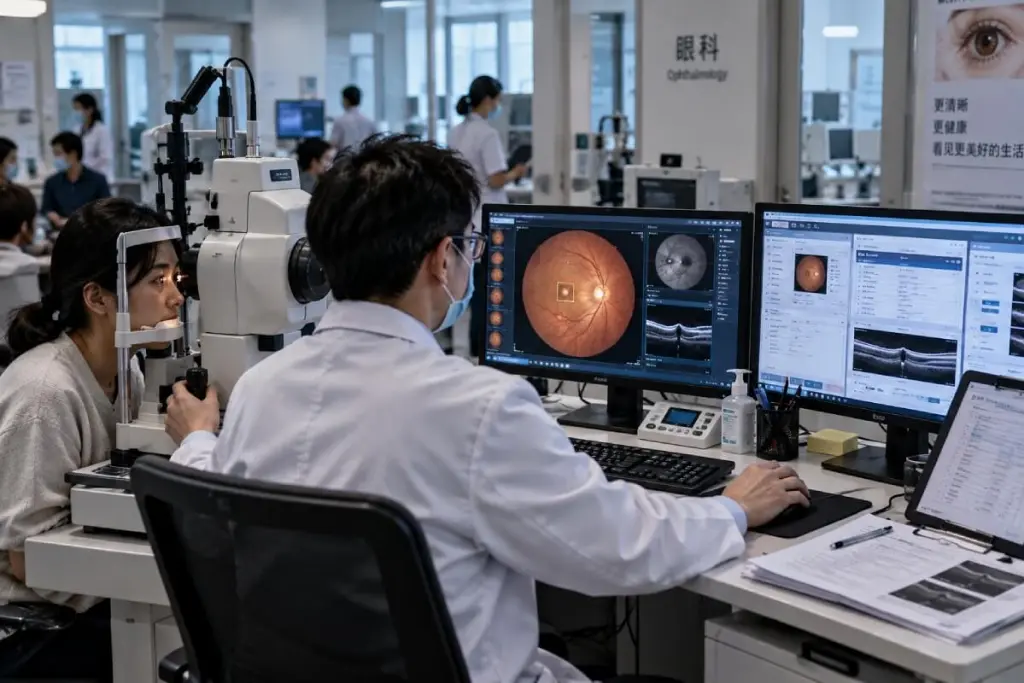
That is why the question of whether this technology is as good as a doctor starts to feel a bit narrow. The Tsinghua case shifts evaluation toward whether opportunities like AI-TEC actually improve care. This means checking whether it lightens the workload, distributes resources more evenly, speeds up decision-making, expands access, and, above all, benefits patients’ health.
What This Deployment Still Does Not Prove
It is also prudent not to jump to the opposite conclusion. Nature Medicine published this work as an analysis article on an early deployment, not as the final clinical trial of an autonomous ophthalmology consultation. The authors present initial lessons and do not prove that AI-TEC can replace ophthalmologists.
Nor does a high AUROC answer all the important questions. The project still must translate strong algorithmic performance into measurable health benefits: more favorable outcomes, reduced staff burden, sustained safety, efficiency, and reproducible results outside the center where it was born.
The good algorithmic performance still needs to translate into measurable health benefits: more favorable outcomes, reduced staff burden, sustained safety, efficiency, and reproducible results.
That caution does not diminish the story; it makes it more interesting. The project turns the medical deployment of artificial intelligence into a system-wide challenge rather than a single machine. Optimizing one piece while others remain uncoordinated can yield a technical marvel with little practical impact. The same difficulty surfaces when an innovation designed for an ideal setting enters institutions governed by real people.
Knowing How to Diagnose Is Not Enough to Function Well in a Hospital
The team adds another day-to-day lesson: waiting weeks to report failures is too slow. The authors call for rapid feedback between clinicians and AI specialists, as well as ongoing monitoring and governance.
That changes a long-held intuition about innovation. For a long time we have asked when artificial intelligence will be precise enough to enter hospitals. The Tsinghua clinic forces us to consider when it will be integrated well enough to deserve staying. The nuance may seem small, but it shifts the emphasis from the machine to the place where it should work.
Perhaps the most valuable takeaway lies there. Medicine turns a competent AI into an ally only when it fits into real life. An algorithm can ace a test in seconds, but incorporating it into an institution requires understanding habits, responsibilities, timing, and human needs.
AI had already shown it could diagnose ophthalmic diseases. The hard part began afterward: proving that it could become part of real medicine.