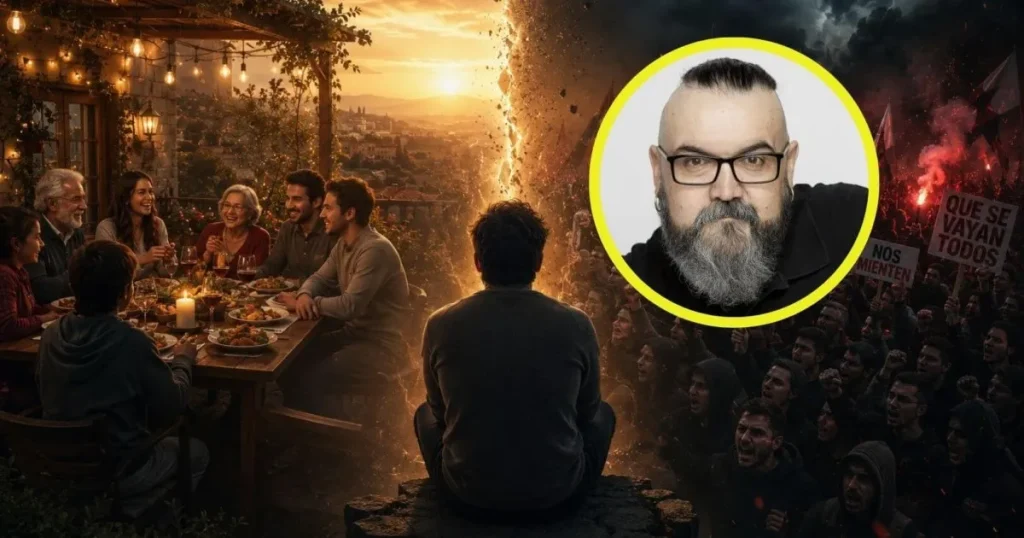
At the end of 2025, a number of Spanish media outlets picked up a demoscopic study, delivered with a sharp edge, claiming that five million Spaniards had severed ties with family and friends over political differences. And that six out of ten people go to great lengths to avoid talking about politics to prevent stirring up trouble… and now that you know it, and you can sense what kind of grim situation we’re stepping into: let’s talk about politics.
If Aristotle was right in saying that human beings are political animals — and he is — it means that being a citizen is an ethical responsibility. For, as you can imagine, in this specific context, “being political” is to belong to the polis, the city. Therefore, being a citizen is one of the fundamental supports of our constitution as human beings: we are beings who, to be truly human, must live together with one another in a defined space, by our own choosing, which we call city, or town, or tribe, or whatever suits best. But if this does not occur, don’t delude yourself; we will never reach our fullness as human beings; we will remain closer to the beast than to the citizen.
So, the moment has come to leap from the “I” — responsible for managing the trust of others and of oneself through personal actions — to a higher, plural, and necessary plane, namely the realm of collective action for the common good. This, and not the mud of the nightly news and televised debate tables, is what “politics” looks like from the eyes of someone like Aristotle or from a writer such as the one who is composing these lines.
I know reality imposes itself, and as much as the previous two paragraphs sound nice, the thought inevitably echoes in your mind with the specter of corruption, the dirt of manners and forms, deceit, pacts and betrayals, the radicalization and polarization of party labels, and everything that makes up the reality of the moment we live in. I know, but try to suspend all of this, put it in parentheses, perform epoche on your emotions, your disgust and visceral reactions, and let us attempt a bit of philosophy.
Confusing “politics” with “political parties” is as common as using “ethics” and “morality” as synonyms, and, although usage makes the norm, we do a poor service to thought by mixing apples and oranges. You’ll see. If ethics is the mode of relation among human beings oriented toward a specific end and morals are the set of rules that order that relation to make possible the promise of the “good life,” then politics will be the way a community organizes itself to achieve that same end. And parties will be one of the many forms of organization of that politics, but not the sole one.
Indeed, and to reinforce these concepts further; it is important to understand that Aristotle didn’t consider politics by chance as the architektoniké, the “supreme science” or “architectural science.” Not because it stood above ethics to correct or replace it, but because it integrated it. If ethics and morality teach us and help us govern ourselves, politics concerns how an entire community can govern itself to achieve the common good. After all, for him, the good of an entire city will always be more perfect than the good of a single individual, because it contains and makes possible the latter.
Pay attention to this last point, which is important. The individual can only fully actualize their humanity thanks to the society that contains them and, recognizing it, gives them existence; not the other way around.
That is why Tacitus is right when he states in his Annals that the more corrupt a nation is, the greater the number of laws. He does not say that the more corrupt is the politician or the individual, but the republic, the sum of all citizens who comprise a concrete society. The corrupt, therefore, is not an isolated individual; they never appear in a vacuum. They are usually the product of the reality of that particular people who, trying to regulate themselves, devote themselves to legislating every possible movement of each one of its members and strata. That does not absolve anyone from the ultimate responsibility for our actions. But together, we are wiser than the four clever ones who draft and enforce the law… You know how it ends.
Aristotle, aware of the vulnerability that afflicted his era and, by his criterion, every era, warned that any form of government, any political organization, will always tend toward corruption for several reasons. The struggle for equality or an inequality that is disproportionate, greed and ambition of rulers and ruled, the desire for recognition, fear of the unknown, and the crowd’s collective contempt for those who are different, along with other factors such as intrigues and pervasive negligence, will be the common pattern by which any monarchy (rule of the best) becomes tyranny; by which aristocracy, the government of the most capable, becomes oligarchy, and by which democracy rots into ochlocracy. That is: the government of the multitude, subdued by the demagogy of those who seek to be named leader by flattering and assaulting others in equal measure. Yes, I know it sounds very modern despite being written more than two millennia ago.
And it is there, in the midst of that crowd inflamed by demagoguery, by the disgusting “and you think you’re next” and the visceral humors emitted by this putrid swamp, that it becomes impossible for us to see and think clearly. And that is where those five million Spaniards decided to sever ties with their loved ones. But by emotionally exiling your friend, your brother, or your neighbor because of the mud of party labels, you are not guarding any kind of moral purity; that does not exist. What you are doing is handing the keys to the polis to those citizens who only look after their own interests, even if they have to destroy the society that gave them their identity. These are the real idiots, in the most classical sense you should already know, those who, knowingly so, are turning democracy into ochlocracy. And remember that ochlocracy is always at the service of the tyrant and his henchmen. The alternative to real politics, therefore, is never the peace of the home; it is, paradoxically, the exposure to the beasts themselves.
But of course, to understand how we raise this vast structure and why we agree to submit to a common order in order not to devour one another, we must first understand what that primordial and ideal pact on which all communities were founded is. But about that “Social Contract” we’ll talk another day. With more time, now take a breath.