
On any Spanish seaside promenade in August, unwittingly coexist a nineteenth‑century dynastic conflict, a round‑trip across the Atlantic, and an episode of nuclear war. A group of “guiris” in flip‑flops asks for “a soft drink” at a “chiringuito” while a local waiter comments on the scene with a sideways smile. None of those words that we use today almost without thinking, however, retains the same meaning they had at their origin.
That is the phenomenon of interest to summer sociolinguistics: not so much what these words designate, but what power relations they reveal between the speaker and what is named. According to the Academia Canaria de la Lengua, several of the most frequently repeated terms along the Spanish coast come from wars, colonial crossings, or dialectical exchanges that had nothing to do with tourism. From the Carlist trench to the beach umbrella, this journey reconstructs the semantic voyage of six everyday words.
The Summer Language as a Social Thermometer
The coastal vocabulary functions as a small seismograph of the tensions generated by mass tourism. A single word can describe an object or a drink and, nevertheless, transform into a label that groups and even stigmatizes millions of people.
The difference between saying “a tourist asked for a soft drink” and “the guiris invade the beach” does not stem solely from register. The first sentence describes a specific action. The second turns a personal experience into a collective trait, with a semantic load that draws on war imagery. Understanding the origin of these words is, therefore, a tool to detect when language stops describing and starts classifying.
From “guiristino” to “guiri”: a civil war that gave the tourist its name
The most revealing case is that of guiri. The term is a shortening of guiristino, itself a deformation of cristino, the term used in the nineteenth century to designate supporters of the regent Maria Christina of Bourbon-Two Sicilies. The historical frame is the First Carlist War, which began in 1833, a dynastic conflict that divided Spain for several years.
In the Basque-speaking zones, “cristino” would have been pronounced “guiristino,” hence the shortening to “guiri.” The subsequent semantic leap, from naming a nineteenth‑century political faction to designating any foreign visitor, fascinates historical linguistics: the label survived almost two centuries after the conflict that spawned it.
Guiri proceeds from guiristino, a deformation of cristino, a term used in the nineteenth century to designate supporters of Regent María Cristina de Borbón-Dos Sicilias.
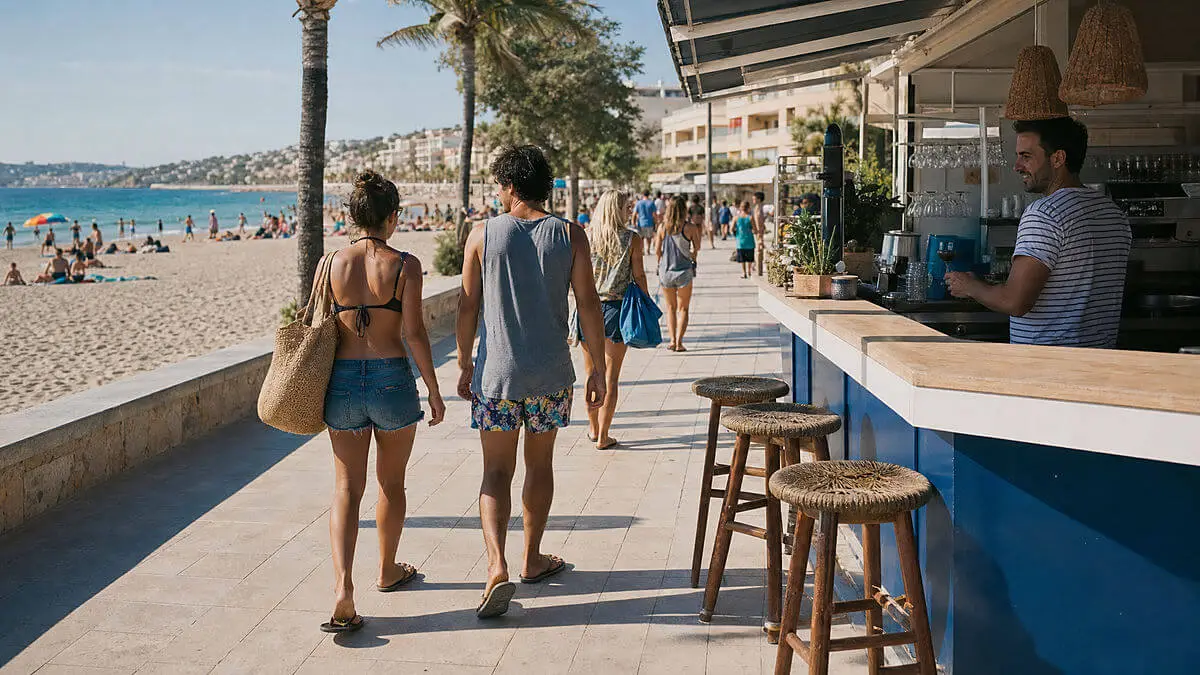
Chiringuito: from the Canary drip to the opaque business
If “guiri” has managed to travel from the Basque Country to the beach, the term chiringuito has covered an even longer journey across the Atlantic. In Cuba, the word was recorded with the sense of “a draught of an alcoholic beverage.” In the Canary Islands, on the other hand, it acquired the meaning of “a small trickle,” perhaps due to association with “chinguito” (chingo alludes to the fine spray of liquid).
From those insular and Caribbean uses, the term became established in Peninsular Spanish with its most familiar sense: an outdoor beverage kiosk, tied to sand and casual leisure. In contemporary journalistic usage, “chiringuito” acquired a second figurative meaning to describe an opaque structure created to benefit a small group.
In Cuba, the word chiringuito was recorded with the sense of “a draught of an alcoholic beverage”.
Refreshment: when register decides the meaning
Against the historical burden of “guiri” and “chiringuito,” refresco seems like an innocuous word. The Dictionnaire étudiant (Diccionario del estudiante) of the RAE defines it as “a refreshing drink, usually non‑alcoholic,” but it also records a less well‑known sense: “a drink and light food served at a gathering.” The meaning, once again, depends on social context.
From Bikini to Vacationer: other words that arrived to stay
The summer semantic field of Spanish extends beyond “guiri” and “chiringuito.” The biquini (the form the RAE recommends over the anglicism “bikini”) emerged in 1946 when the French designer Louis Réard named his two‑piece swimsuit thus. He chose the name after the Bikini Atoll in the Marshall Islands, where the United States had recently conducted a nuclear test: he wanted his design to make as explosive an impact.
The veraneante, by contrast, is a word purely of home manufacture in Castilian. It derives from “veranear,” a bourgeois practice of the nineteenth century that consisted of moving to the coast or to the mountains during the warm months. Unlike “guiri,” it never acquired a comparable pejorative charge, perhaps because it described a custom of locals rather than outsiders.
Finally, sombrilla illustrates a simpler naming process. It is a straightforward diminutive of “sombra.” Its etymological simplicity stands in contrast to the historical complexity of its beachside neighbors and reminds us that not every summer word reflects a conflict.
The French designer Louis Réard named his two‑piece swimsuit “biquini” after the Bikini Atoll, where the United States had conducted a nuclear test a few days earlier.
Talking about tourism without falling into cliché
From this journey, which runs from a Carlist war to a nuclear test in the Pacific, emerges a conclusion that applies to any text about tourism. The words of summer are not neutral: they carry centuries of history and, with every use, decide whether we describe or label.