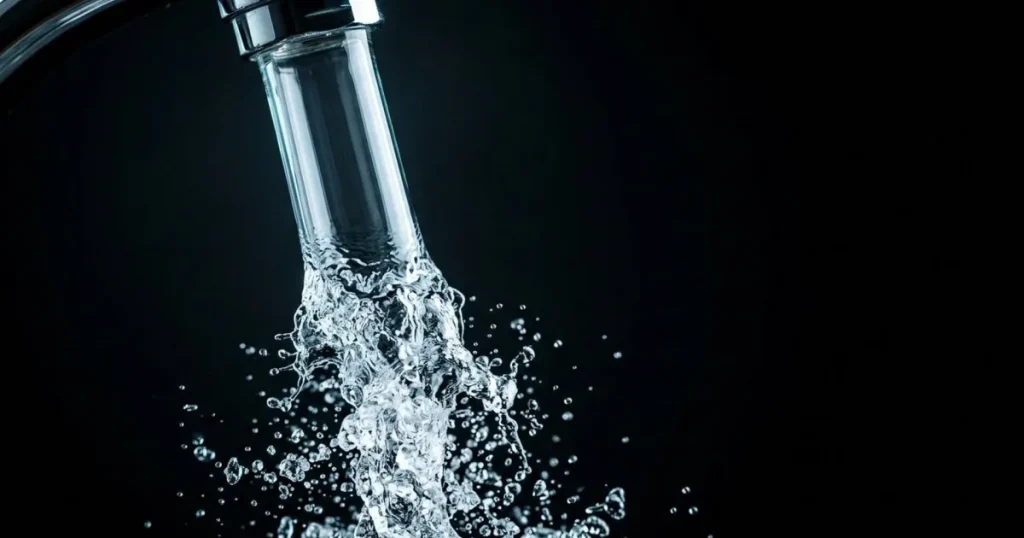
Open it all the way. The first few centimeters come out smooth, transparent, almost solid, like a crystal rod. And then, at a precise height, the water breaks apart: it becomes white, noisy, unpredictable. The same equations describe the jet before and after that point, and no one has managed to prove that they don’t break exactly there. They are the Navier-Stokes equations, and the Clay Institute of Mathematics pays a million dollars to anyone who can close that proof.
The Million-Dollar Prize That No One Has Claimed Yet
Navier–Stokes describe how any fluid moves: smoke, blood, a storm. It works so well that we use it daily, but no one has proven that its solutions always exist. In September 2026, an AI took a huge step in that direction. Not the step the headlines claim.
- 88 hours and about 10,000 agents in parallel. That was the duration of the search; formalizing the proof took 17 more hours.
- The proof needs to push the fluid. The Millennium Prize requires a fluid with no external forces, and that case remains open.
- The key idea was Spanish. Diego Córdoba and Luis Martínez-Zoroa designed the cascade of vortices the machine carried to the end.
- Not even OpenAI itself claims the million. The Clay Institute still lists Navier–Stokes as an unsolved problem.
- The equations are from 1822 and 1845. Navier arrived at them from a molecular model that modern physics discarded; Stokes reformulated them twenty-three years later.
On September 8, 2026, OpenAI announced that an internal system still in training had produced a computer-verified proof that a three-dimensional fluid can develop a finite-time singularity. The headlines did the rest: the machine had solved in three and a half days what humanity had not managed in a century. The prize, however, remains unclaimed, and the company itself said in its announcement that it does not intend to claim it.
To understand why, you have to go back to the faucet.
What Exactly Do the Navier–Stokes Equations Describe
Navier–Stokes is not a single equation, but a system of partial differential equations that answers a very specific question: given a fluid at a given instant, where will every part of that fluid be one second later? The system translates into mathematical language the three things that push a liquid or a gas: pressure, external forces like gravity, and the internal friction within the fluid itself, the resistance to flow that we call viscosity.
With them you design airplane wings, forecast a storm, compute how blood circulates through a narrowed artery, and model the flow in a river. They work so well that they underpin half of contemporary engineering. And that is precisely the problem.
We rely daily on equations whose solutions we do not know to exist for all time. Engineering has two centuries of advantage over proof.
A French Engineer and an Irish Physicist
The equations have two fathers and twenty-three years between them. Claude-Louis Navier derived them in 1822 from a molecular model that later physics discarded: he imagined forces between particles that do not behave as he believed. He arrived at the correct expression by the wrong route, something that happens more often in the history of science than is told.
In 1845, George Gabriel Stokes re-derived them from the mechanics of continua, treating the fluid not as a swarm of particles but as a continuous substance that deforms under stress. Stokes achieved the same system with solid foundations, and that is why we know them today by the double name.
In the meantime and afterwards, physics accumulated a catalog of phenomena that the equations described without anyone fully explaining them. The stubbornest of all is turbulence: the apparent disorder in the jet, in the smoke from a cigarette, or in an aircraft’s wake that still has no closed theory almost two centuries later.
What It Really Means to Solve the Problem
In 2000, the Clay Institute selected seven Millennium Problems and placed a million dollars on each. Charles Fefferman drafted the official statement for Navier–Stokes, and it is worth reading slowly because almost nobody does. What it asks for is not to compute fluids, but to prove that the computation never breaks: that starting from a smooth state, the solutions exist forever and remain smooth.
Smooth, in mathematics, does not mean that the water stays calm. It means that the solution does not develop jumps or blow up. If there exists a moment when some fluid quantity becomes infinite, there is a singularity, and the theory ceases to be valid right where it is most needed. No one has proven that this cannot happen. No one has proven the opposite either. That is why the problem has sat on unresolved-problem lists for decades.
If the proof is correct, the conclusion is awkward: the equations allow a perfectly regular state to, by its own dynamics, reach a point where it ceases to be.
The difficulty has a identifiable culprit: the system’s nonlinear term, the one that describes how the fluid drags itself along and feeds its own vortices. That term is what prevents long-term control of the solution and what turns a problem in applied physics into one of the century’s seven great mathematical enigmas.
The 88 Hours and What Was Actually Proven
The OpenAI system worked with about 10,000 agents in parallel and reached the answer on September 5, 2026, roughly 88 hours after starting the search. The formalization and verification in Lean, a proof assistant that checks every logical step without trusting human intuition, consumed another 17 hours.
The statement proven is very precise, and that precision is the whole news: a three-dimensional fluid initially smooth and at rest, subejected to a gentle external force and with finite energy, develops a singularity in finite time. The solution they found is a vortex, a whirlpool that spins inward and keeps stretching more and more.
There is the nuance that the headlines missed. The statement that earns the million does not allow pushing the fluid from the outside, and that difference is not a technicality: an external force can be designed precisely to trigger the blow-up. It is the distance between proving that a car can crash and proving that it can crash on its own.
The Cascade That Came from Madrid
The 88 hours did not start from zero. In 2023, Diego Córdoba, from the Institute of Mathematical Sciences (ICMAT-CSIC), and Luis Martínez-Zoroa, now a professor at CUNEF University, published a strategy to manufacture singularities by stacking layers of vorticity. The idea is to chain infinite non-singular solutions that, combined, generate a cascade capable of breaking the fluid’s regularity. It worked, but it required a rough forcing, mathematically awkward.
Tristan Buckmaster and Levent Alpöge refined that forcing until it became a smooth function and extended the result to the three-dimensional Euler equations. What the machine did was traverse the last stretch of a path laid out for years, at a speed no human team could match.
AI did not open the path. It walked it all the way in the time a PhD student takes to read the problem’s bibliography.
The first version of OpenAI’s announcement did not cite the two Spanish mathematicians: the references appeared hours later, in an updated version. It is not the first time that a machine crosses paths with another mathematical problem and the discussion ends up revolving around who signs what.
What Remains Unproven
The Clay Institute does not hand out prizes for announcements. It requires that the solution be published in a venue that meets its requirements, that at least two years pass, and that the mathematical community accept it broadly. None of those three conditions has been fulfilled yet, and the problem’s official page still lists it as open.
There is also a confusion worth clearing up. Lean checks that the logical chain of what is formalized has no holes, but it does not decide whether what is formalized is the Millennium Statement. Formal verification guarantees internal coherence, not mathematical relevance, and that second judgment remains human and slow by design.
Nor should we look at the water glass with suspicion. The singularity is a property of the model, not of the liquid: no real fluid will reach infinite velocity just because the equations allow it on paper. What has moved is the boundary of what is provable, not the boundary of what is possible.
The hardest part remains, and it is precisely what no one has touched: the same blow-up without pushing the fluid from the outside. There the million dollars still stands, and there the faucet’s jet still breaks at the same height as always.